


Wildfire Smoke and Bird Diversity: Why Environmental Impacts Can Extend Beyond the Burn Area
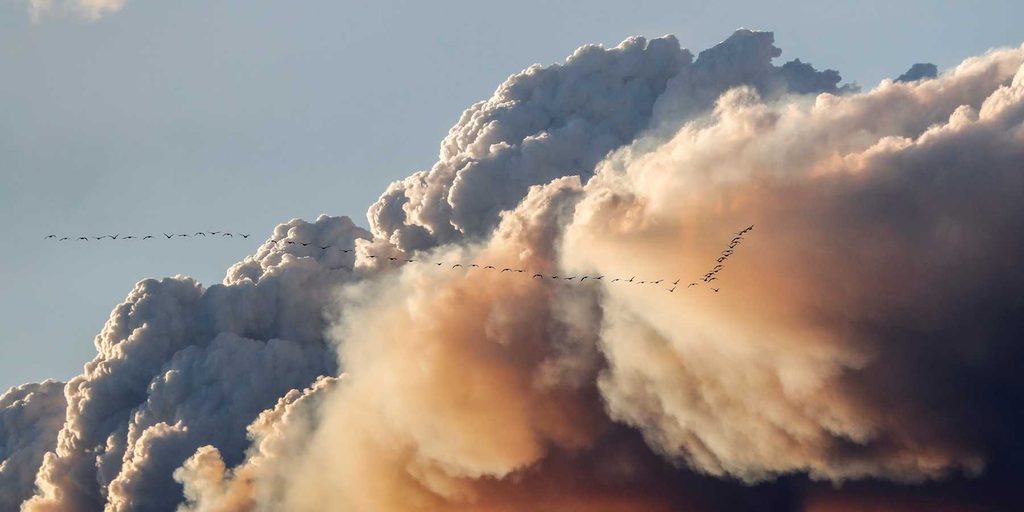
The environmental impact of a wildfire does not necessarily stop where the flames end.
Smoke can travel tens, hundreds or sometimes thousands of kilometres from a fire, carrying fine particulate matter into places that never burn.
A 2026 study examining bird communities across the United States now suggests that this transported pollution may have ecological consequences that persist beyond the smoke event itself.
Researchers analysing approximately 15 years of data found that areas experiencing greater exposure to wildfire-related fine particulate matter in one year tended to show lower bird diversity during the following breeding season.
Importantly, the relationship remained detectable even when the researchers examined locations where nearby habitat had not burned.
That finding broadens an important environmental-management question.
Wildfire assessment traditionally focuses heavily on the area burned, habitat destroyed, property lost and immediate air-quality deterioration.
The new research suggests that environmental monitoring may also need to consider ecological effects occurring outside the fire perimeter and after the visible smoke has disappeared.
What did the researchers investigate?
The study was conducted by Sarah Meier of ETH Zürich and Eric Strobl of the University of Bern and published in the Journal of Environmental Economics and Management.
The researchers combined information from the North American Breeding Bird Survey with high-resolution estimates of particulate pollution attributable specifically to wildfire smoke.
The bird survey has operated since 1966.
Each year, trained observers travel established routes approximately 40 kilometres long and record birds seen or heard at about 50 predetermined stops.
For this research, Meier and Strobl analysed approximately 2,800 routes across the contiguous United States over the 2008–2022 period.
The researchers were interested in more than simply the total number of birds.
They examined several dimensions of biodiversity, including:
- Species richness
- Bird abundance
- How evenly birds were distributed among species
- Phylogenetic diversity, reflecting how evolutionarily different the observed species were
The peer-reviewed study reports adverse associations between wildfire-specific PM2.5 exposure and several taxonomic and phylogenetic biodiversity measures.
Why PM2.5 matters
PM2.5 refers to airborne particulate matter with an aerodynamic diameter of approximately 2.5 micrometres or smaller.
Because these particles are small, they can remain suspended in the atmosphere and travel well beyond the immediate source.
Wildfire smoke is a complex mixture rather than a single pollutant.
For this particular study, however, wildfire-attributable PM2.5 served as the primary pollution-exposure measure.
That distinction matters.
The study is not evidence that every component of wildfire smoke has the same ecological effect, nor does it identify a particular chemical component as responsible for the observed changes.
It assesses the relationship between estimated wildfire-specific fine-particle exposure and subsequent bird-community outcomes.
What did the study find?
The peer-reviewed paper reports that a one-standard-deviation increase in wildfire-specific PM2.5 pollution reduced species richness, abundance and phylogenetic diversity by approximately 0.1 standard deviations.
At the most heavily exposed survey transects, the estimated effect reached approximately two standard deviations for some biodiversity measures.
ETH Zürich provides a more intuitive interpretation.
When smoke exposure increased from an average year to what the university describes as a substantially smokier year, the number of bird species in the following breeding season declined by approximately 3%.
An average survey route contained around 55 species, meaning that the change corresponded to roughly one or two fewer species.
The decline was substantially larger at some of the most heavily smoke-exposed monitoring locations.
A 3% average decline may sound small.
Ecologically, however, the significance depends partly on which species are affected, their ecological roles and whether losses are temporary or persistent.
Those questions were not answered by this study.
Smoke exposure occurred before the biodiversity change
Timing is one of the most interesting features of the research.
The study did not simply compare birds and smoke occurring at the same moment.
Greater wildfire-smoke exposure in the preceding year was associated with reduced bird diversity in the following breeding season.
That raises questions about effects that may extend beyond the period of visibly poor air quality.
However, the research does not establish the biological sequence responsible.
Possible pathways could include effects on health, survival, migration, reproduction, food availability or behaviour, but those explanations require additional evidence.
The study itself does not determine which mechanism produced the observed population-level patterns.
Did habitat destruction explain the result?
Wildfires present a difficult scientific problem because smoke exposure is often accompanied by other environmental stresses.
Fire can destroy habitat.
Drought and extreme heat can affect wildlife independently.
Vegetation and food resources can change.
Birds can move away from disturbed areas.
If researchers simply compared smoky locations with less smoky locations, those factors could easily confuse the interpretation.
Meier and Strobl therefore used an econometric approach incorporating panel fixed effects and instrumental-variable estimation to separate wildfire-specific PM2.5 exposure from other influences.
According to ETH Zürich, the analysis accounted for factors including weather, land use and differences in bird-survey implementation.
The researchers also examined routes where there was no burned area within five kilometres.
The adverse smoke relationship remained.
They additionally tested whether apparent biodiversity declines could simply reflect birds moving into neighbouring areas, and the relationship remained after those local shifts were considered.
These tests strengthen the argument that smoke itself deserves attention.
They do not, however, turn the study into a controlled toxicology experiment.
Association, causal inference and biological mechanism are different questions
This distinction is important for environmental communication.
The researchers used sophisticated statistical methods intended to identify the effect of wildfire smoke rather than merely describe an uncontrolled correlation.
That provides stronger causal evidence than a simple cross-sectional comparison.
But the underlying data remain observational.
The study does not expose individual birds to measured concentrations under controlled conditions and then document specific biological responses.
It therefore cannot establish from these data alone exactly how smoke affected individual animals.
ETH Zürich explicitly states that the research does not reveal what happened to the birds.
Other research has raised possibilities including respiratory injury, weight loss or behavioural changes, but those mechanisms should not be attributed to the birds in this dataset without direct evidence.
A responsible interpretation is therefore:
The study provides evidence that wildfire-specific PM2.5 exposure can affect observed avian biodiversity, while the biological mechanisms driving those changes remain unresolved.
Three different biodiversity questions
One strength of the study is that biodiversity was not reduced to a single number.
Species richness asks how many different species occur at a site.
Abundance considers how many birds are recorded.
Phylogenetic diversity considers how evolutionarily distinct the community is.
These measures describe different ecological characteristics.
A site could theoretically retain the same number of species while losing substantial numbers of individual birds.
Alternatively, it could lose a small number of species that represent unusually distinct evolutionary lineages.
Monitoring programmes therefore become more informative when they consider multiple ecological endpoints rather than relying on species counts alone.
Why bird diversity matters
Birds perform numerous ecological functions.
Depending on the ecosystem and species involved, these can include seed dispersal, pollination, insect predation and other interactions that influence vegetation and food webs.
ETH Zürich notes that changes in bird diversity could therefore have consequences extending into agriculture, forestry and wider ecosystem functioning.
The study does not, however, quantify those economic consequences.
It would therefore be inappropriate to assign a monetary loss to the observed biodiversity changes based on this research alone.
The researchers deliberately stopped short of doing so.
Why this matters for Trinidad and Tobago
The U.S. results should not be transferred directly to Trinidad and Tobago.
The countries differ in climate, vegetation, bird communities, fire regimes, landscape configuration, meteorology and many other factors.
There is currently no basis from this study for claiming that a particular wildfire-smoke exposure causes a 3% decline in Trinidad and Tobago bird diversity.
But the underlying monitoring question is relevant.
Vegetation and forest fires occur during Trinidad and Tobago’s dry season.
The Ministry of Agriculture and Fisheries states that the statutory Fire Season extends from December 1 through June 30, with Forestry Division patrols intensified during the hottest portion of the dry season.
In one documented example, the Forestry Division recorded 75 fires affecting 326.58 hectares by March 12, 2023 across its conservancies and National Parks operations.
Those figures should not be interpreted as evidence of smoke-related bird losses.
They establish something more limited but important:
Trinidad and Tobago experiences landscape fires capable of generating smoke, while simultaneously managing forest and wildlife resources.
That creates a legitimate opportunity for local research examining whether ecological consequences extend beyond visibly burned areas.
The monitoring boundary should extend beyond the fire perimeter
Traditional post-fire environmental assessment may focus strongly on the area directly burned.
That remains important.
But smoke behaves differently from flames.
Fine particles move with atmospheric conditions.
A site several kilometres from a fire may experience substantial smoke exposure even though its vegetation remains physically intact.
That means the ecological exposure zone may be larger than the burn scar.
For environmental monitoring, this has practical implications.
A study designed only around burned versus unburned land could miss potentially relevant smoke exposure among apparently unaffected habitats.
Air monitoring and biodiversity monitoring should work together
The new study demonstrates the value of integrating different datasets.
For a local investigation, one useful approach would be to combine:
- Continuous or time-resolved PM2.5 measurements
- Meteorological data
- Fire occurrence and burn-area records
- Satellite smoke observations where available
- Repeated bird surveys
- Habitat and land-use information
- Reference or lower-exposure monitoring locations
The objective would not be simply to ask whether birds are present after a fire.
The stronger question is whether ecological indicators change systematically with documented smoke exposure after other important environmental factors are considered.
Measuring PM2.5 is not the same as identifying its source
This distinction is especially important in the Caribbean.
Ambient PM2.5 can originate from numerous sources.
These can include vehicle emissions, industrial activity, combustion, dust and other regional or local sources.
A monitor showing elevated PM2.5 does not by itself establish that the particles came from a wildfire.
Source attribution requires additional evidence.
Depending on the investigation, this could include meteorological observations, fire records, satellite imagery, wind direction, temporal patterns or more specialised chemical and source-apportionment methods.
Environmental monitoring should therefore separate two questions:
How much particulate matter is present?
and
What evidence identifies its source?
Those are not the same question.
Baseline monitoring matters
One of the difficulties in detecting biodiversity effects is knowing what conditions existed before an event.
If bird surveys begin only after smoke exposure occurs, natural variability can make the results difficult to interpret.
The same applies to air-quality measurements.
Long-term monitoring creates a baseline against which unusually smoky conditions can be compared.
Repeated ecological surveys can then help distinguish short-term variability from more persistent change.
The North American study was possible partly because researchers could draw on many years of standardized bird-monitoring data.
That is a valuable lesson for Caribbean environmental management.
Long-term environmental datasets can answer questions that one-off surveys cannot.
A practical Trinidad and Tobago monitoring framework
A local pilot study could begin by identifying forest or vegetation-fire hotspots alongside ecologically relevant bird habitats.
Ambient PM2.5 could then be monitored before, during and after the dry-season fire period.
Meteorological measurements would be important because wind direction, wind speed, rainfall and atmospheric mixing influence where smoke travels.
Ecological surveys could be conducted using repeatable observation methods at locations representing different exposure conditions.
Burned habitat should be mapped separately so that direct habitat destruction can be distinguished from possible off-site smoke exposure.
Where possible, reference sites outside major smoke plumes should also be monitored.
The programme should continue across more than one season.
A single fire event would provide useful observations but would be insufficient for making robust general conclusions.
What the research does not establish for the Caribbean
The study does not demonstrate that wildfire smoke has already reduced bird diversity in Trinidad and Tobago.
It does not establish a Caribbean PM2.5 threshold for ecological effects.
It does not identify which local bird species would be most sensitive.
It does not show that every measured PM2.5 increase during the dry season originates from fire.
It does not prove that the observed U.S. biodiversity response would occur in tropical bird communities at the same exposure level.
And it does not provide a regulatory air-quality standard designed specifically to protect birds.
Local investigation would be required.
Where Ecotox can contribute
Ecotox Environmental Services has verified capabilities that align directly with the air-quality component of this type of investigation.
Its ambient-air monitoring services include measurement of PM1.0, PM2.5, PM10 and total suspended particulates, alongside pollutants including carbon monoxide, sulphur dioxide, nitrogen oxides and ozone.
Ecotox also uses meteorological stations alongside ambient-air monitors to provide environmental context for measured concentrations.
For wildfire- or vegetation-smoke investigations, that capability could support:
- Baseline ambient-air monitoring
- PM2.5 and PM10 measurements
- Meteorological monitoring
- Spatial comparison between monitoring locations
- Before-, during- and after-event monitoring
- Environmental monitoring-programme design
- Integration of air-quality results with other environmental datasets
Where a project requires specialised ecological survey expertise, smoke-source modelling or advanced source-apportionment analysis beyond verified Ecotox capability, the appropriate approach would be to establish the monitoring objectives and work with qualified ecological or technical partners where required.
That preserves scientific integrity while allowing air-quality measurements to become part of a broader environmental investigation.
From air pollution to ecological intelligence
One of the most important lessons from this study is methodological.
An air-quality measurement tells us about pollutant concentrations.
A bird survey tells us something about an ecological community.
A wildfire map tells us where land burned.
Each dataset is useful.
But when they are analysed together, they can answer a much more valuable question:
Can pollution generated in one place influence ecosystems somewhere else and at a later time?
That is a more sophisticated form of environmental intelligence.
It connects the source, pathway, exposure and receptor rather than treating each component independently.
Conclusion
The study by Meier and Strobl suggests that wildfire impacts can extend substantially beyond the area physically burned.
Across approximately 2,800 U.S. bird-survey routes observed from 2008 through 2022, greater wildfire-specific PM2.5 exposure was associated with lower species richness, abundance and phylogenetic diversity in the subsequent breeding season.
The researchers took extensive steps to separate smoke exposure from habitat destruction, weather, land use and local movement.
But the study does not reveal precisely what happened to individual birds or establish a physiological mechanism.
For Trinidad and Tobago, those U.S. effect sizes should therefore not be imported as local predictions.
The more useful lesson is the monitoring principle.
A fire’s environmental footprint may extend beyond its burn scar.
Understanding that footprint requires air-quality measurements, meteorological information and ecological observations to be considered together.
That approach can help move wildfire assessment from simply documenting what burned toward understanding what the wider environment was actually exposed to.
Linked Sources
Meier & Strobl (2026) — The impact of wildfire smoke on local avian biodiversity
University of Birmingham — Peer-reviewed study record and abstract
ETH Zürich — Forest fire smoke reduces bird diversity
Trinidad and Tobago Ministry of Agriculture & Fisheries — Forestry Division Fire Patrol System