


Can Irrigation Reduce Greenhouse Gas Emissions?
Why a New U.S. Study Calls for Full-System Accounting
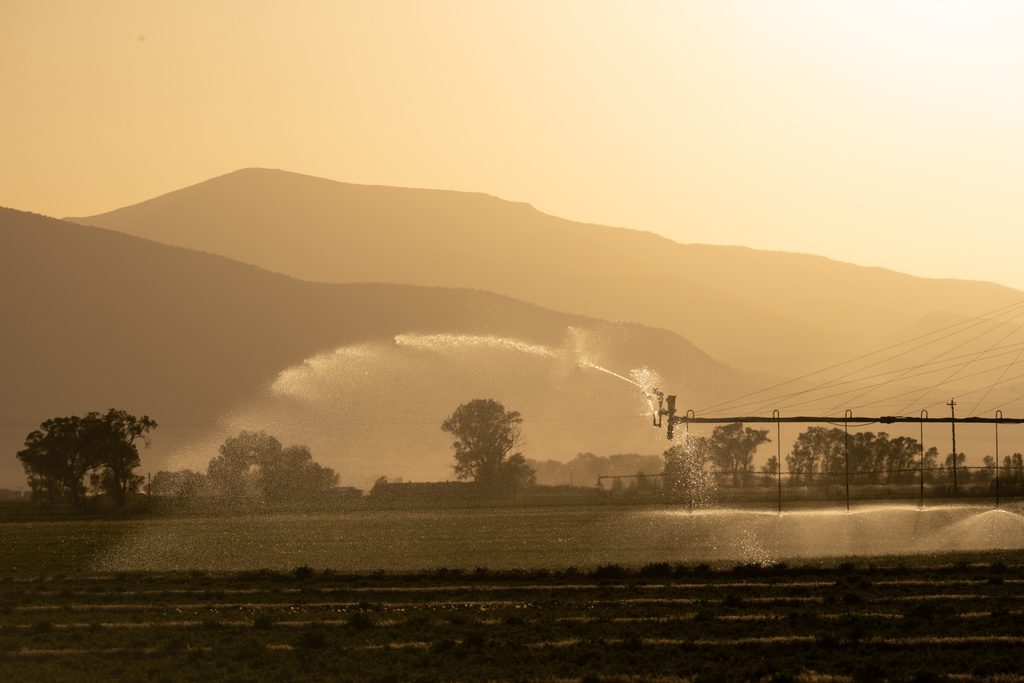
Irrigation requires water and energy, and pumping that water can generate greenhouse gas emissions.
So it may seem intuitive that reducing irrigation would also reduce agricultural emissions.
A new study led by researchers at Colorado State University shows why environmental accounting can be more complicated.
The researchers concluded that irrigation’s effect on crop productivity can influence how much land is required elsewhere to produce the same amount of food.
When agricultural yields increase, less additional land may need to be converted from forests or other natural ecosystems into farms.
That avoided land conversion can prevent the release of carbon stored in vegetation and soils.
For U.S. irrigated agriculture, the researchers modelled this indirect greenhouse-gas benefit as substantially larger than the direct greenhouse-gas emissions associated with irrigation.
But that conclusion requires careful interpretation.
The research does not establish that irrigation is environmentally beneficial everywhere.
It does not eliminate concerns about water scarcity, groundwater depletion, environmental flows, soil degradation, nutrient losses or energy consumption.
And its U.S. results cannot simply be transferred to Trinidad and Tobago or the wider Caribbean.
Instead, the study demonstrates something particularly useful for environmental management:
Environmental decisions can change when we expand the boundary of what is being measured.
What did the researchers investigate?
Avery W. Driscoll and colleagues examined the greenhouse-gas consequences of irrigated agriculture in the United States.
The study, titled Global greenhouse gas cobenefits of US irrigated agriculture, was published online in the Proceedings of the National Academy of Sciences on September 14, 2026.
Rather than considering only emissions produced directly by irrigation, the researchers examined both direct emissions and indirect land-use effects.
Direct irrigation emissions can arise from energy used to pump and transfer water, as well as other irrigation-related processes.
Indirect effects arise because irrigation can increase agricultural productivity.
If irrigated farmland produces more food than the same land would under rainfed conditions, removing irrigation could require additional agricultural land elsewhere to compensate for the lost production.
The researchers therefore asked a broader question:
What happens to global land use and greenhouse-gas emissions if U.S. agriculture no longer receives the productivity benefits associated with irrigation?
How the study was conducted
The research combined several modelling stages.
First, the team estimated the effect of irrigation on crop yields at county level across the United States.
Existing agricultural survey information was combined with a machine-learning approach to estimate differences between irrigated and rainfed production.
The researchers then introduced those productivity differences into a global economic model that represents agricultural production, consumption and trade.
The model estimated how food production might shift geographically if U.S. irrigated agriculture instead operated under rainfed conditions.
Those projected changes were then translated into changes in land use.
Finally, the researchers used information on carbon stored in vegetation and soils to estimate greenhouse-gas emissions associated with the modelled conversion of natural ecosystems to agricultural uses.
This is therefore not a field experiment in which researchers physically stopped irrigation and measured subsequent global emissions.
It is a counterfactual modelling study.
That distinction is essential when interpreting the results.
What did the study find?
The researchers estimated that irrigation increases U.S. crop production by approximately 3% to 39%, depending on crop type.
They also estimated at least US$31.9 billion in additional agricultural revenue associated with those productivity benefits.
When the productivity effect was introduced into the global land-use model, the researchers projected that U.S. irrigation prevents substantial additional conversion of natural ecosystems.
Their modelling estimated avoided net conversion of approximately:
- 32 million hectares of forest
- 7 million hectares of other natural vegetation
The model also projected changes involving approximately 35 million hectares of grassland and 4 million hectares of cropland as agricultural production reorganised globally.
From those modelled land-use changes, the researchers estimated a gross greenhouse-gas benefit of 6.86 gigatonnes of CO₂-equivalent associated with land sparing.
By comparison, direct emissions associated with current U.S. irrigation were estimated at approximately 0.019 Gt CO₂e per year.
The researchers describe the avoided land-use emissions benefit as equivalent to approximately 363 years of current annual U.S. irrigation emissions.
What the “363 times” figure actually means
This is one of the most important points for responsible communication of the study.
The finding should not be rewritten as:
“U.S. irrigation reduces greenhouse-gas emissions by 6.86 Gt every year.”
That is not what the paper reports.
The 6.86 Gt CO₂e figure is a modelled gross land-use-change benefit associated with avoiding ecosystem conversion under the researchers’ counterfactual scenario.
The 0.019 Gt CO₂e figure is an annual estimate of direct irrigation emissions.
Dividing the gross avoided land-use emissions by annual direct emissions produces the study’s approximately 363-year comparison.
This difference in time basis matters.
The research provides evidence that avoided land conversion can be extremely important in agricultural climate accounting.
It does not mean that irrigation creates an annual carbon offset 363 times larger than its annual emissions.
Why land conversion matters
Forests, grasslands and other natural ecosystems store carbon in vegetation and soils.
When natural ecosystems are cleared or substantially altered for agricultural production, some of that stored carbon can be released to the atmosphere.
Land conversion can also affect biodiversity, hydrology, erosion, habitat connectivity and ecosystem services.
Increasing agricultural productivity on existing farmland can therefore create what researchers often call a land-sparing effect if the additional production genuinely reduces pressure to convert natural ecosystems elsewhere.
But that final condition is important.
Higher yields do not automatically guarantee that land will be protected.
Economic demand, commodity prices, trade, policy, land tenure and other factors can influence whether productivity increases translate into actual land sparing.
That is one reason modelling assumptions matter when estimating indirect land-use effects.
Irrigation still produces emissions
The study is not an argument that irrigation has no greenhouse-gas footprint.
Pumping water requires energy.
The emissions associated with pumping depend partly on the depth and distance over which water must be moved, the efficiency of the pumping system and the energy source supplying it.
The Colorado State University research team identifies pumping as the dominant direct emissions source associated with irrigation in the United States.
The researchers therefore highlight pump electrification and electricity-grid decarbonisation as potential ways of reducing direct irrigation emissions.
That creates an important environmental-management principle.
A practice can provide a broader environmental benefit while still containing individual impacts that should be reduced.
The appropriate response is not necessarily to classify the entire activity as either “good” or “bad.”
It is to identify the individual environmental pressures and manage them.
Greenhouse gases are only one part of irrigation’s environmental footprint
An irrigation system can perform favourably in a greenhouse-gas model while creating pressure elsewhere.
Water abstraction can affect rivers, aquifers, wetlands and downstream users.
Excessive groundwater withdrawal can reduce water tables.
Poor irrigation management can contribute to waterlogging or salinisation in susceptible environments.
Agricultural runoff can transport sediment, nutrients and pesticides into rivers, wetlands and coastal waters.
Changing soil moisture can also influence nutrient cycling and greenhouse-gas production.
These effects cannot be resolved simply by knowing how many tonnes of CO₂-equivalent may have been avoided through land sparing.
A defensible environmental assessment therefore needs to consider multiple environmental indicators simultaneously.
Why this matters for Trinidad and Tobago
The U.S. numerical findings should not be transferred directly to Trinidad and Tobago.
Agricultural systems, rainfall patterns, crop types, farm sizes, soils, energy systems, irrigation infrastructure and land-use pressures differ substantially.
However, the underlying decision-making lesson is highly relevant.
Trinidad and Tobago is actively working to improve agricultural productivity and resilience.
The Ministry of Agriculture and Fisheries identifies irrigation and water management among the areas supported through agricultural advisory and incentive programmes.
Recent agricultural initiatives have also included irrigation upgrades and improved irrigation practices for crops such as rice and specialty peppers.
These developments raise an important environmental question.
As agricultural irrigation expands or becomes more technologically intensive, how can increased food production be achieved while protecting water resources, soil quality and surrounding ecosystems?
Answering that question requires local measurements.
What should an agricultural environmental-monitoring programme measure?
A strong irrigation-monitoring programme should begin with the decision that the data need to support.
For example, a programme investigating irrigation-water suitability may require different sampling locations and analytical parameters from one examining agricultural runoff, groundwater effects or soil salinity.
A broader environmental programme could consider irrigation-water quality, surface-water conditions, groundwater levels and quality, soil properties, nutrient concentrations, suspended sediment, drainage water and potential contaminant transport.
Baseline measurements are particularly important.
Without reliable information collected before a change in irrigation practice or agricultural development, it becomes harder to determine whether later environmental changes were associated with the project or were already present.
Monitoring should also account for seasonality.
In Trinidad and Tobago, wet- and dry-season conditions can alter water availability, runoff, contaminant transport and irrigation demand.
A single sampling event may therefore provide an incomplete picture.
From carbon accounting to environmental accounting
One of the strongest lessons from the Colorado State University study extends beyond agriculture.
Environmental decisions depend heavily on where the assessment boundary is drawn.
Looking only at irrigation pumps captures one category of emissions.
Adding soil and field processes broadens the picture.
Adding changes in crop productivity broadens it further.
Including global land-use responses changes it again.
The same systems-thinking approach applies to environmental monitoring.
A water sample from an irrigation canal may describe water quality at one location and time.
It does not necessarily explain the source of a contaminant, its movement through soil, its effect on groundwater, its downstream fate or its ecological significance.
Environmental intelligence becomes stronger when individual measurements are connected into a wider system.
What the study does not establish
The research does not demonstrate that all irrigation should be expanded.
It does not show that every irrigated farm provides a net greenhouse-gas benefit.
It does not establish that water consumed for irrigation is environmentally sustainable.
It does not eliminate the need to protect environmental flows or groundwater resources.
It does not quantify the environmental consequences of irrigation expansion in Trinidad and Tobago.
And it does not mean that land conversion would necessarily occur exactly where the model projects if U.S. irrigation were removed.
Those are important limitations because the major climate result depends on a modelled counterfactual rather than an observed global removal of irrigation.
Where Ecotox can contribute
Ecotox Environmental Services provides capabilities directly relevant to the environmental side of agricultural and irrigation management.
These include groundwater, riverine, stormwater and potable-water sampling; soil sampling; environmental analytical testing; and environmental monitoring-programme design and implementation.
For agricultural developments, these capabilities can support:
- Baseline water and soil characterisation
- Irrigation-water quality assessment
- Groundwater and surface-water monitoring
- Soil and sediment sampling
- Agricultural runoff investigations
- Nutrient and contaminant monitoring
- Environmental monitoring programme design
- Evaluation of changes through time
The objective is not to assume that irrigation is producing an environmental problem.
It is to establish reliable evidence capable of showing whether one exists.
Likewise, Ecotox should not claim greenhouse-gas modelling or carbon-accounting services unless those capabilities have been specifically verified.
Where specialised modelling or analyses are required beyond verified capability, the appropriate role is to help establish the environmental monitoring and data requirements and work with suitable technical partners where necessary.
A better question for climate-smart agriculture
The question should not simply be:
“Does irrigation generate greenhouse gases?”
It clearly can.
Nor should the question simply be:
“Does irrigation reduce greenhouse gases?”
Under the specific U.S. scenario examined by the researchers, their modelling suggests a substantial avoided land-use benefit.
The more useful question is:
What is the complete environmental balance of the agricultural system we are actually managing?
That balance includes productivity.
It includes greenhouse-gas emissions.
But it also includes water demand, water quality, energy use, soil condition, nutrient management, land conversion and ecosystem effects.
Conclusion
The Colorado State University-led study provides a valuable example of why environmental accounting must consider indirect as well as direct effects.
By increasing crop productivity, U.S. irrigation may reduce pressure for agricultural expansion elsewhere.
The researchers modelled 6.86 Gt CO₂e of gross avoided land-use-change emissions, compared with approximately 0.019 Gt CO₂e of annual direct irrigation emissions.
That is a substantial result.
But it is a modelled U.S. result—not a universal environmental licence for irrigation expansion.
For Trinidad and Tobago and the Caribbean, the most useful lesson is therefore not the 363-fold headline.
It is the analytical approach behind it.
Environmental decisions improve when we examine the complete system, measure the relevant local conditions and distinguish direct observations from modelled indirect effects.
For agriculture, that means pairing productivity and climate objectives with scientifically defensible monitoring of water, soil and surrounding ecosystems.
That is the foundation for genuinely climate-smart and environmentally responsible agricultural development.
Linked Sources
Driscoll, A.W. et al. (2026). Global greenhouse gas cobenefits of US irrigated agriculture. Proceedings of the National Academy of Sciences, 123(39), e2528170123. DOI: 10.1073/pnas.2528170123.
PNAS — Primary peer-reviewed study
Trinidad and Tobago Ministry of Agriculture & Fisheries — Agricultural information and programmes
Ecotox Environmental Services — Specialized Sampling Services