


Tyre Wear Pollution in Urban Dust: Why Air and Stormwater Monitoring Must Work Together
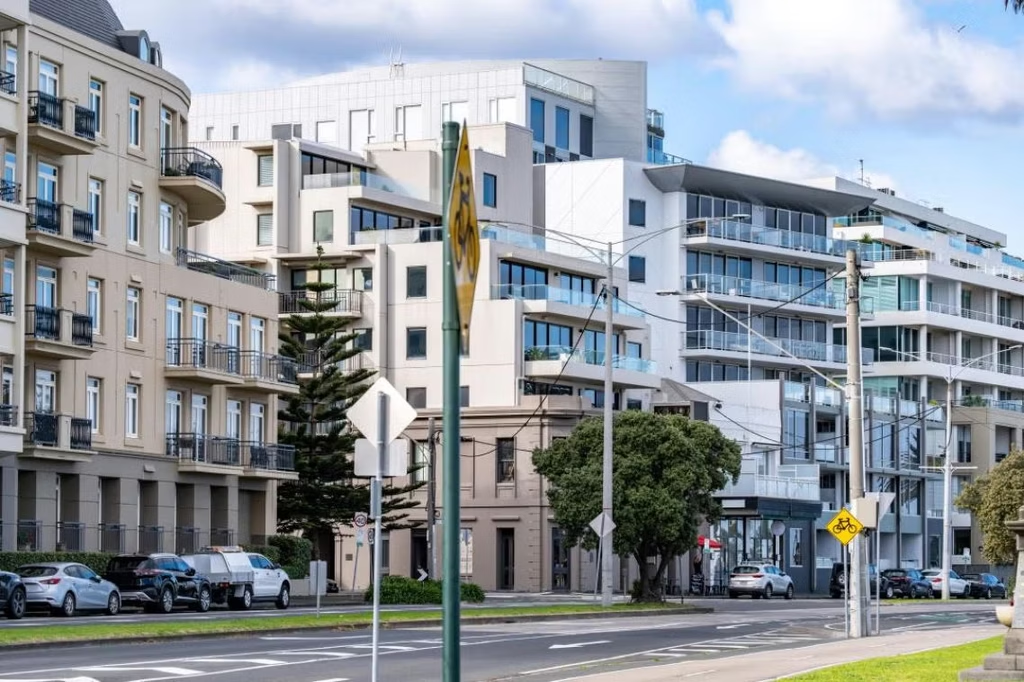
Traffic pollution is often discussed in terms of exhaust gases, smoke and fine particulate matter. But every journey also produces non-exhaust emissions as tyres repeatedly contact and abrade against road surfaces.
The resulting material does not simply disappear.
Tyre wear particles can accumulate on roads, disperse through the air, settle in residential and commercial areas or be washed into drainage systems during rainfall. These pathways make tyre wear pollution an emerging issue across air-quality management, stormwater control and aquatic environmental protection.
A new field study from Brisbane, Australia, has now quantified tyre particles and associated chemicals in dust collected from residential balconies. The results show why environmental monitoring cannot rely exclusively on traffic exhaust measurements or general particulate concentrations.
What the Brisbane researchers found
Researchers from the University of Queensland examined dust collected from 30 outdoor residential balconies across inner-city, suburban and near-road settings in the Brisbane metropolitan region.
Samples were collected between June 2024 and March 2025. According to the University of Queensland research summary, tyre-related chemical additives were detected on 29 of the 30 balconies.
One chemical of particular environmental concern, 6PPD-quinone, was detected on 23 balconies. Other targeted tyre-related chemicals included:
- Hexa(methoxymethyl)melamine, or HMMM
- 2-(4-Morpholinyl)benzothiazole, or 24MoBT
- 5-methylbenzotriazole, or 5-MBTR
Balconies closer to Brisbane’s central business district and those closer to ground level generally had higher concentrations of tyre-related pollution. Wind conditions were also associated with the amount deposited.
These patterns support the conclusion that material released at road level can be transported through the urban atmosphere and deposited beyond the road itself.
How the particles and chemicals were measured
The study published in ACS ES&T Air used two complementary analytical techniques:
- Pyrolysis gas chromatography–mass spectrometry to quantify tyre-wear particle mass
- Liquid chromatography–tandem mass spectrometry to measure selected tyre additive chemicals
This distinction is important.
Tyres are complex products made from synthetic and natural rubbers, fillers, reinforcing materials and numerous chemical additives. Measuring the mass of tyre-derived particles does not automatically reveal the concentration of individual chemicals associated with them.
The researchers reported tyre-wear particle deposition ranging from below 0.0006 to 4.1 milligrams per square metre per day, with a median of 0.3 milligrams per square metre per day.
Total loadings of the targeted tyre additive chemicals ranged from below 0.01 to 316 nanograms per square metre per day, with a median of 69 nanograms per square metre per day. These results are summarized in the ACS supporting research record.
More particles did not always mean more chemicals
One of the study’s most significant findings was that tyre-particle mass and tyre-additive concentrations did not consistently move together.
The ratio between additive chemicals and tyre-particle mass varied by more than two orders of magnitude across the sampling sites. Balconies near Brisbane’s central business district had particularly elevated chemical-to-particle ratios.
This suggests that atmospheric transport may do more than move particles from one location to another. Weathering, chemical transformation, redistribution and differences in particle composition may alter the relationship between the amount of tyre material and the chemicals deposited with it.
The study did not establish every process responsible for those differences. Nevertheless, its results demonstrate why total dust or total tyre-particle mass cannot serve as a reliable substitute for targeted chemical analysis.
An effective monitoring programme may need to examine both:
- The particulate component: How much tyre-derived material is present?
- The chemical component: Which additives and transformation products are present, and at what concentrations?
What is 6PPD-quinone?
The distinction between a tyre additive and its transformation product is especially important for 6PPD-quinone.
6PPD is added to tyres to protect rubber from degradation caused by ozone and other reactive compounds. When 6PPD reacts with ozone, it can form a transformation product called 6PPD-quinone, commonly abbreviated as 6PPD-Q.
Therefore, 6PPD-quinone is not simply an ingredient intentionally added to tyres. It is a chemical that can form as the parent additive reacts in the environment.
The United States Environmental Protection Agency explains that tyre abrasion releases particles containing these substances. Rain can then wash tyre-derived material from streets and parking areas into streams and other receiving waters.
A widely cited 2021 study in Science identified 6PPD-quinone as the chemical responsible for acute mortality in coho salmon exposed to contaminated urban stormwater in the Pacific Northwest.
That finding is important, but it must be interpreted correctly.
Coho salmon sensitivity does not establish the same toxicity threshold for every aquatic species. Toxicity can vary substantially among species and life stages. The salmon research also does not prove that concentrations measured in Brisbane balcony dust caused ecological or human-health effects.
What the balcony study does not prove
The Brisbane research provides evidence of environmental occurrence and atmospheric transport. It was not a human-health study.
The researchers measured deposited outdoor dust—not personal inhalation exposure, breathing-zone air concentrations, indoor contamination, absorbed dose or clinical health outcomes.
A balcony acting as a “sink” means that airborne material accumulated on that surface. It does not mean that all deposited material was inhaled or ingested by residents.
Important limitations include:
- The study examined 30 balconies in one metropolitan area.
- Conditions in Brisbane cannot be applied automatically to other cities or climates.
- Sampling covered a limited deployment period rather than continuous multi-year monitoring.
- Observed associations with location, height and wind do not by themselves establish every source or transport process.
- The study did not compare pollution from electric and internal-combustion vehicles.
- It did not conduct a residential human-health risk assessment.
- It did not measure ecological effects in receiving waters.
- It targeted selected tyre chemicals rather than every additive or transformation product.
The results demonstrate a potential exposure pathway and an environmental monitoring need. They do not establish that residents experienced a specific health effect.
The EPA likewise notes that information about the human-health effects of 6PPD-quinone remains limited. Environmental detection should therefore prompt disciplined investigation rather than unsupported medical conclusions.
Why routine air monitoring may miss the source
Conventional air-quality programmes commonly measure pollutants such as:
- PM₂.₅
- PM₁₀
- Total suspended particulates
- Nitrogen dioxide
- Sulphur dioxide
- Ozone
- Carbon monoxide
- Volatile organic compounds
These measurements are essential, but a total particulate result generally does not identify which portion came from tyres, brakes, road surfaces, soil, construction, sea salt, combustion or another source.
A low-cost particulate sensor may indicate that particle concentrations increased. It cannot normally determine whether those particles contain tyre rubber or 6PPD-quinone.
Source-specific tyre pollution assessment may require:
- Deposited-dust collection
- Road-dust sampling
- Size-fractionated particulate sampling
- Chemical-marker analysis
- Tyre-polymer mass analysis
- Meteorological measurements
- Traffic and land-use information
- Appropriate field blanks and contamination controls
Analytical methods, detection limits and quality-assurance procedures must be selected before sampling begins. Microplastic and trace-organic analysis can be particularly vulnerable to contamination and method-dependent results.
Airborne deposition becomes a stormwater issue
Tyre pollution crosses conventional environmental-management boundaries.
Material deposited on roads, rooftops, parking areas and other hard surfaces may later be mobilized by rainfall. It can move through gutters, drains and stormwater channels before entering rivers, wetlands, harbours or coastal waters.
This creates a connected pathway:
flowchart TD
    A["Tyre and road abrasion"] --> B["Airborne particles"]
    A --> C["Road-surface deposits"]
    B --> D["Urban dust deposition"]
    C --> E["Rainfall and stormwater"]
    D --> E
    E --> F["Rivers, sediments and coastal waters"]
The amount transported will depend on traffic intensity, surface type, rainfall, drainage infrastructure, street cleaning, particle size and local hydrology.
Short, intense rainfall following a dry period may mobilize accumulated road dust rapidly. This makes event-based stormwater sampling important: routine sampling on dry days may miss the period when contaminant transport is greatest.
Caribbean relevance must be measured locally
The Brisbane findings do not prove that equivalent concentrations occur in Port of Spain, San Fernando, Chaguanas, Kingston, Bridgetown or another Caribbean urban centre.
Traffic patterns, vehicle fleets, road surfaces, building design, wind, rainfall and drainage systems differ. Caribbean concentrations and risks must therefore be established through Caribbean measurements.
Nevertheless, the source-to-receptor pathway is relevant to regional environmental planning.
Caribbean investigations may need to consider:
- High-traffic roads near homes, schools and commercial districts
- Open-air residential and occupational environments
- Dust accumulation during dry periods
- Wet-season transport through stormwater systems
- Direct drainage into rivers, wetlands, harbours and coastal waters
- Maintenance of catch basins and roadside drains
- Exposure of aquatic organisms in receiving environments
- Cumulative pollution from traffic, industry and urban runoff
The purpose of monitoring would not be to assume that Brisbane’s results have been replicated. It would be to determine whether tyre-derived particles and chemicals are present locally, where they accumulate and which environmental receptors may be exposed.
Building an integrated tyre-pollution monitoring programme
A defensible programme should connect sources, environmental transport and potential receptors.
| Monitoring component | What it helps determine |
|---|---|
| Traffic and land-use assessment | Where tyre-wear generation and residential or ecological exposure may be greatest |
| Ambient particulate monitoring | How general airborne-particle concentrations vary by location and time |
| Deposited-dust sampling | What accumulates on surfaces beyond the roadway |
| Road-dust sampling | What is available for wind redistribution or stormwater transport |
| Targeted tyre-polymer analysis | How much tyre-derived particulate material may be present |
| Tyre-additive analysis | Whether chemicals such as 6PPD-Q or other targeted compounds are present |
| Stormwater event sampling | What is mobilized during rainfall and transported through drains |
| Water and sediment sampling | Whether contaminants reach rivers, wetlands or coastal receiving environments |
| Ecological assessment | Whether measured exposure may represent a risk to local organisms |
Site selection should include source-proximal locations, residential receptors, drainage pathways, receiving environments and suitable background or comparison sites.
Sampling should also account for:
- Wet- and dry-season conditions
- Rainfall intensity and antecedent dry periods
- Wind speed and direction
- Balcony or sampler height
- Distance from major roads
- Traffic volume and vehicle type
- Surface cleaning and disturbance
- Construction and other competing dust sources
- Sample preservation and chain of custody
- Laboratory detection limits and method uncertainty
Repeated measurements are necessary to distinguish isolated detections from persistent patterns.
Monitoring should guide practical controls
Environmental evidence can help determine which control measures deserve priority.
Depending on the source and pathway, options may include:
- Improved road and catch-basin cleaning
- Better management of contaminated street sweepings
- Stormwater filtration and sediment capture
- Vegetated swales and appropriate bioretention systems
- Drainage maintenance before heavy-rainfall periods
- Reduced unnecessary vehicle travel
- Tyre maintenance and correct inflation
- Procurement standards supporting lower-wear tyres
- Safer tyre formulations and chemical alternatives
- Monitoring before and after pollution-control measures
Not every intervention will work equally well in every catchment. Monitoring is needed to confirm whether a control captures particles, reduces chemical concentrations or simply transfers contamination to another environmental compartment.
How Ecotox can support tyre-pollution investigations
Ecotox Environmental Services can support integrated urban pollution programmes through:
- Air-quality and particulate monitoring
- Deposited-dust and specialized environmental sampling
- Roadside and source-pathway investigations
- Stormwater sampling
- Riverine and marine receiving-water sampling
- Soil and sediment sampling
- Environmental analytical-testing programmes
- Environmental baseline studies
- Ecological risk assessment
- Environmental impact assessment
- Construction and operational compliance monitoring
Where advanced tyre-polymer or trace-additive analysis is required, the sampling programme should establish the correct analytical method, containers, preservation requirements, reporting limits and laboratory quality controls before field deployment.
Learn more about Ecotox’s specialized environmental sampling services.
The road is only the beginning of the pathway
The Brisbane study expands the way tyre pollution should be understood.
Tyre-derived material was not confined to road surfaces. It was transported through the atmosphere and deposited in outdoor residential spaces. Just as importantly, chemical-additive concentrations did not consistently track total tyre-particle mass.
That means one measurement cannot represent the entire problem.
A credible assessment must distinguish particle mass from chemical composition and connect airborne deposition with road dust, rainfall, stormwater and receiving environments.
For Caribbean environmental management, the study is not evidence of a predetermined local result. It is a strong reason to ask a locally answerable question:
Where does tyre wear pollution go after it leaves the road?
Sources
- Kaur, S., Thomas, K. V. and Rauert, C. From Streets to Seats: Assessment of Tire Wear Particles and Tire Additive Chemicals in Australian Urban Dust. ACS ES&T Air, 2026.
- American Chemical Society. Study abstract and supporting research record
- University of Queensland. Microplastic tyre pollution found in Brisbane balcony dust
- Queensland Alliance for Environmental Health Sciences. Tracking tyre-related microplastic pollution
- United States Environmental Protection Agency. 6PPD-quinone
- Tian, Z., et al. A ubiquitous tire rubber-derived chemical induces acute mortality in coho salmon. Science, 2021.