


Drought Can Concentrate Disease Risk: Why Environmental Surveillance Must Track Water Stress
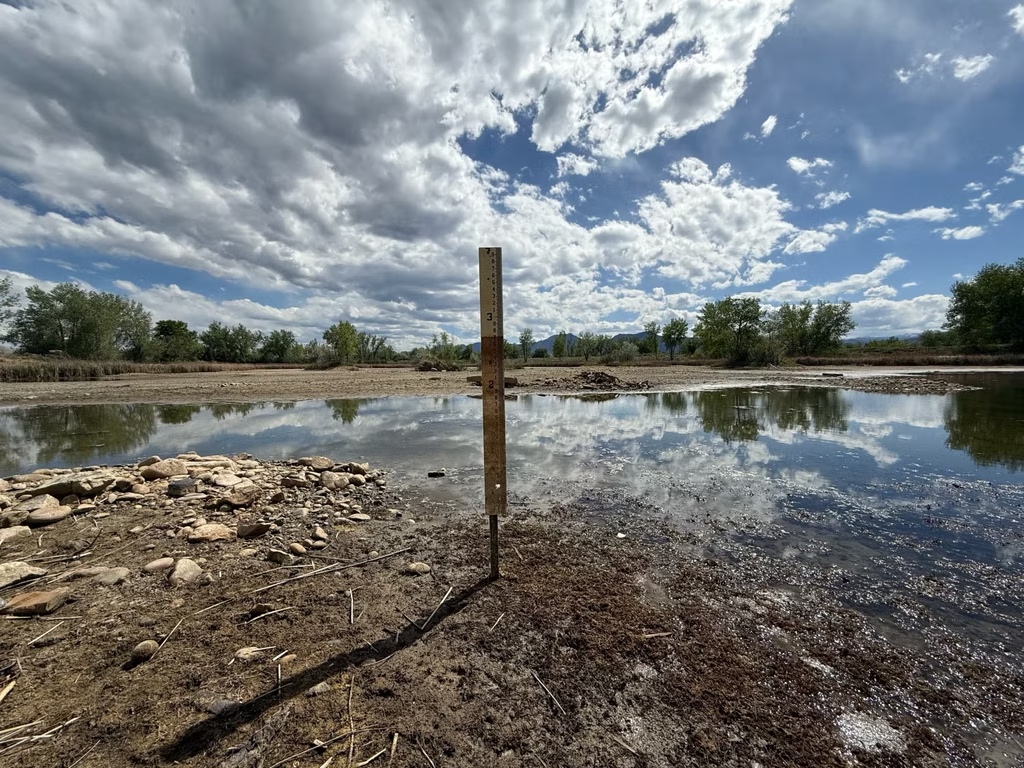
Drought reduces water across a landscape, but it does not necessarily reduce every water-associated disease.
Shrinking rivers, ponds and wetlands can eliminate some parasites and vectors. They can also force wildlife, livestock, insects and people to depend on fewer remaining water sources, increasing contact and concentrating environmental hazards.
A new scientific review explains this apparent contradiction by examining how drought reorganizes relationships among pathogens, parasites, hosts and their environments.
The findings have important implications for the Caribbean, where water scarcity, changing rainfall patterns and vector-borne disease risks increasingly intersect. They also demonstrate why drought preparedness must include water-quality testing, ecological monitoring and coordinated environmental-health surveillance.
What did the researchers study?
Researchers Pieter Johnson of the University of Colorado Boulder and Tara Stewart Merrill of the Cary Institute of Ecosystem Studies synthesized findings from nearly 100 previous studies.
Their review, published in Trends in Ecology & Evolution, is titled Plagued by drought: how water scarcity reshapes host–parasite interactions.
This was not a new clinical trial or a single outbreak investigation. It was a scientific synthesis intended to explain why water scarcity suppresses some diseases but amplifies others.
The researchers identified three broad ecological mechanisms:
- Drought concentrates organisms in shrinking water refuges.
- It selectively favours hosts, vectors and pathogens that tolerate dry conditions.
- It creates uneven disease-transmission patterns across a landscape.
Together, these mechanisms help explain why a drying environment can produce both disease hotspots and transmission dead ends.
Mechanism 1: Concentration in shrinking water sources
When drought causes ponds, rivers or wetlands to contract, animals may congregate around the water that remains.
This increases the potential for:
- More frequent contact among members of the same species
- New contact among different wildlife or livestock species
- Greater overlap between hosts and parasites
- Higher concentrations of faecal matter, nutrients and contaminants
- Shorter distances between aquatic parasites and potential hosts
- Increased pressure on water sources shared by people and animals
Under these conditions, a smaller water body may become a transmission hotspot.
The review includes examples of drought concentrating amphibians and their parasites in California ponds. Researchers observed that some infections became more severe because the remaining aquatic habitat brought susceptible hosts and parasites closer together.
But concentration does not always increase transmission. If the water body dries completely before a parasite finishes its lifecycle, the site can become what the researchers call a “desiccation trap.” Parasites, vectors or intermediate hosts may die before transmission occurs.
The outcome therefore depends on the timing, duration and intensity of the drought.
Mechanism 2: Selection for drought-tolerant organisms
Drought acts as an ecological filter.
Organisms that depend on continuous water may decline, while species capable of surviving heat, dryness, salinity or temporary habitat loss may become more dominant.
This can change:
- Host-community composition
- Predator abundance
- Vector populations
- Parasite survival
- Food-web interactions
- Competition among species
Mosquito responses demonstrate this complexity.
Severe drying may eliminate mosquito habitat. Moderate water loss can instead create shallow, warm and stagnant pools that support certain mosquitoes. Reduced water volume may also remove aquatic predators, including organisms that feed on mosquito larvae.
Human water-storage practices can add another layer. Where unreliable supply leads households or facilities to store water, poorly covered or maintained containers may provide breeding habitat for container-adapted mosquitoes.
These factors do not mean drought will automatically increase every mosquito-borne disease. Vector species, storage practices, temperature, rainfall timing, control measures and human exposure all influence the final outcome.
Mechanism 3: Greater variation across the landscape
Drought rarely affects every water body equally.
Some ponds disappear. Others contract but persist. Reservoirs, drains, livestock watering points, household containers and groundwater-fed pools may retain water after surrounding habitats have dried.
This creates a more uneven landscape in which:
- Certain locations become highly concentrated refuges
- Other locations lose both hosts and pathogens
- Wildlife movement changes
- Vector habitat becomes clustered
- Transmission may intensify locally even if it declines regionally
A regional average can therefore hide important hotspots.
Environmental surveillance needs sufficient spatial coverage to identify where water persists, where hosts gather and where water quality is deteriorating.
Drought also changes water quality
Water quantity and water quality cannot be treated as separate issues.
As water levels decline, temperature, salinity and contaminant concentrations can change. Lower flow can reduce dilution and increase the residence time of pollutants.
Potential changes include:
- Higher water temperature
- Lower dissolved oxygen
- Increased salinity or conductivity
- Greater turbidity
- Concentrated nutrients
- Higher proportions of wastewater or runoff
- Increased algal or microbial activity
- Greater contaminant exposure
- Changes in pH
- Increased stress on fish, amphibians and other aquatic organisms
The effect on disease depends on the organisms involved.
Some parasites may be damaged by higher temperatures, salinity or complete drying. Others may tolerate the altered conditions better than their hosts or ecological competitors.
Environmental stress can also affect host health, potentially changing susceptibility to infection.
Human water security is part of the disease pathway
Drought-related infectious-disease risk is not controlled solely by natural ecology.
Water infrastructure, sanitation, health services, household behaviour and access to safe water can either amplify or reduce risk.
When established supplies become unreliable, communities may depend more heavily on:
- Stored water
- Water delivered by truck
- Rainwater tanks
- Private wells
- Rivers and springs
- Small community systems
- Alternative sources that receive less frequent testing
If these supplies are inadequately protected, treated or monitored, exposure risk may change.
Drought can also reduce the water available for sanitation and hygiene. At the same time, concentrated wastewater discharges can place additional pressure on low-flow rivers and receiving environments.
The ecological framework therefore needs to be combined with water-safety planning and public-health surveillance.
Important scientific limitations
The new publication proposes a general framework based on evidence from many host–parasite systems. It does not predict the outcome of every drought or pathogen.
Several limitations matter:
- The reviewed studies covered different climates, species, parasites and drought definitions.
- Some findings came from wildlife or experimental systems rather than human populations.
- Disease responses can be nonlinear.
- Short dry periods may produce different outcomes from multiyear droughts.
- Complete drying can suppress transmission, while partial drying may concentrate it.
- Temperature, land use, sanitation and human behaviour can modify the drought effect.
- An association between drought and disease does not automatically establish drought as the sole cause.
- Results from Florida, California, East Africa or other regions cannot be assumed to describe Caribbean transmission patterns.
The review should therefore guide local surveillance and research—not replace them.
Why this matters for the Caribbean
The World Meteorological Organization reported severe Caribbean water shortages during 2025 and observed that rainfall across parts of Latin America and the Caribbean is shifting toward longer dry spells and more intense wet events.
This alternating pattern matters because disease risk may change during both drought and subsequent rainfall.
During dry periods:
- Remaining water sources can become concentrated
- Household water storage may increase
- Low-flow rivers may receive less dilution
- Wildlife and livestock may gather around limited water
- Groundwater abstraction and salinity pressures may increase
When rain returns:
- Accumulated contaminants can be mobilized
- New temporary mosquito habitats may form
- Drains and storage systems may refill
- Runoff can transfer faecal material, waste and sediment into water bodies
The Caribbean Public Health Agency already recognizes the importance of combining climate information with environmental and health monitoring. Its Caribbean Health-Climatic Bulletin is designed to help health professionals prepare for climate-sensitive risks, including vector-borne and gastrointestinal illnesses.
In 2026, PAHO, WHO and national governments also published climate-and-health profiles for seven Caribbean countries, including Trinidad and Tobago. Their recommendations included stronger integrated risk surveillance, early-warning systems and intersectoral cooperation.
These priorities align closely with the new drought–disease framework.
What should environmental surveillance monitor?
Water availability
Monitoring should track rainfall, stream flow, pond and reservoir levels, groundwater levels, water-storage practices and the duration of temporary water bodies.
The rate at which a site is drying can be as important as its final water level.
Physical and chemical water quality
Relevant parameters can include:
- Temperature
- pH
- Dissolved oxygen
- Conductivity and salinity
- Turbidity
- Total dissolved and suspended solids
- Nutrients
- Organic loading
- Selected metals or contaminants
- Residual disinfectant in treated supplies
These measurements help identify environmental conditions that may favour particular hosts, vectors or microbial hazards.
Microbiological indicators
Where drinking, recreational or community water supplies are involved, appropriate microbiological testing may include indicators such as Escherichia coli, faecal coliforms, enterococci and other parameters required by applicable standards.
Disease-specific testing should be coordinated with qualified public-health laboratories and authorities.
Vector habitat
Surveillance should document persistent standing water, containers, drains, ponds, wetlands and other potential breeding habitats.
Vector monitoring should be paired with water and climate data so that changes can be interpreted in context.
Wildlife and livestock concentration
Areas where animals gather around shrinking water sources may warrant ecological observation and targeted environmental sampling.
The objective is not to assume that wildlife presence equals disease. It is to identify changing contact networks and potential exposure pathways.
Wastewater and sanitation pressures
Low receiving-water flows can reduce dilution of treated or untreated discharges. Monitoring should assess outfalls, sanitation infrastructure, overflow risks and water bodies used downstream.
Dry-to-wet transitions
Sampling should continue when drought ends.
The first major rainfall after an extended dry period can move accumulated contaminants, sediment and waste into rivers, drains, coastal waters and reservoirs.
Building climate-informed early-warning systems
The strongest surveillance programmes combine multiple types of information:
- Meteorological forecasts
- Drought indicators
- Water-level observations
- Water-quality results
- Vector surveillance
- Wildlife observations
- Public-health case data
- Infrastructure and sanitation reports
No single dataset can explain disease transmission by itself.
When these systems are connected, authorities can identify whether environmental changes are preceding shifts in vectors, pathogens or reported illness. This can improve the timing of sampling, inspections, public communication and control measures.
How Ecotox can support environmental preparedness
Ecotox Environmental Services can support the environmental component of drought and disease-risk assessment through:
- Surface-water and groundwater sampling
- Specialized environmental sampling
- Water-quality monitoring
- Environmental baseline studies
- Soil and sediment assessment
- Ecological risk assessment
- Environmental impact assessment
- Monitoring of industrial and wastewater receiving environments
- Construction and operational compliance monitoring
- Investigation of contaminant pathways
- Long-term environmental data collection
Disease diagnosis and epidemiological surveillance remain the responsibility of appropriate medical and public-health authorities. Environmental monitoring complements those systems by identifying the changing conditions through which exposure may occur.
Explore Ecotox’s Environmental Monitoring and Sampling Services.
Conclusion
Drought does not simply remove water and make water-associated diseases disappear.
It reorganizes ecosystems.
Shrinking water bodies can concentrate hosts, vectors, parasites and contaminants. Complete drying can interrupt transmission. Drought-tolerant organisms may gain an advantage, while environmental risk becomes increasingly uneven across the landscape.
The scientific evidence therefore supports a conditional conclusion: some diseases will decline under drought, while others may intensify in specific locations and circumstances.
For the Caribbean, the practical response is not to assume which outcome will occur. It is to monitor water quantity, water quality, vectors, ecosystems and public-health indicators together.
As rainfall becomes more variable, environmental surveillance must become more integrated, spatially targeted and responsive to both drought and the return of rain.
Sources
- Johnson and Stewart Merrill — Plagued by drought: how water scarcity reshapes host–parasite interactions, Trends in Ecology & Evolution
- University of Colorado Boulder — Drought is reshaping the spread of infectious diseases
- World Meteorological Organization — State of the Climate in Latin America and the Caribbean 2025
- PAHO — Caribbean climate and health country profiles
- CARPHA — Environmental Health and Sustainable Development
- Pan American Journal of Public Health — Regional model for vector-borne disease preparedness in the Caribbean