


Forest Nitrogen Cycling Under Rising CO₂: Why Soil Monitoring Matters
Rising atmospheric carbon dioxide can stimulate photosynthesis, but extra CO₂ alone does not guarantee that forests will continue growing faster or storing more carbon.
Trees also need nitrogen, phosphorus, water and other resources. Whether forests can obtain those resources—and how soil microorganisms respond—will strongly influence their future role as natural carbon sinks.
New research from a mature oak woodland in England shows that elevated CO₂ can change forest nitrogen cycling in a surprisingly coordinated way. Trees released more carbon through their roots, soil microorganisms made nitrogen available more rapidly, and the ecosystem appeared to conserve that nitrogen more effectively.
The study offers valuable evidence about how trees and microbes may adapt to future atmospheric conditions. It also reinforces why forest-carbon assessments must look below ground.
What did the researchers investigate?
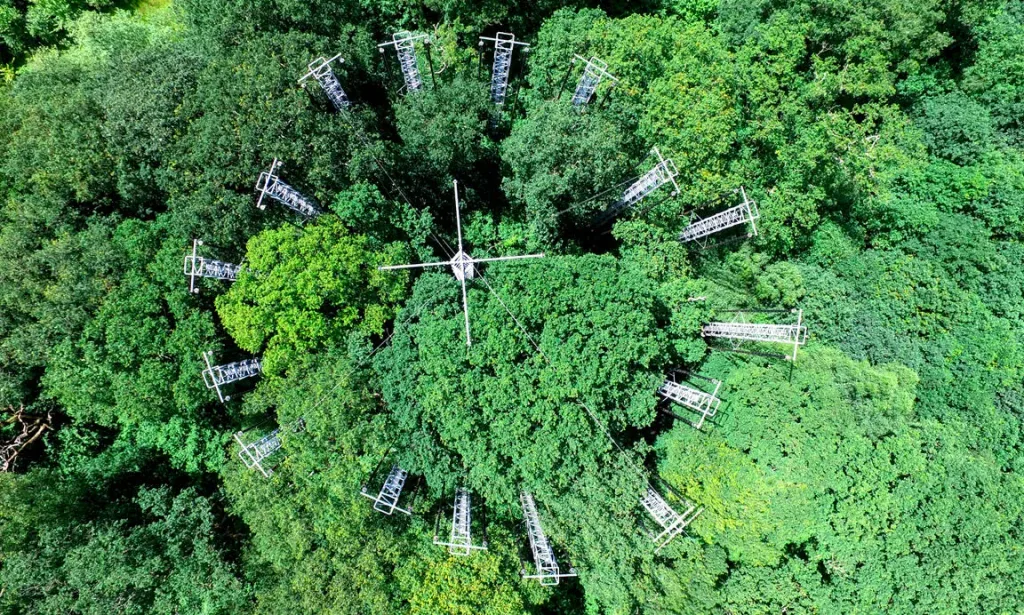
The research was conducted at the University of Birmingham’s Free-Air Carbon Dioxide Enrichment facility, known as BIFoR FACE.
The facility surrounds sections of a mature English oak woodland with vertical pipes that release CO₂ directly into the forest canopy. Unlike a greenhouse experiment, the trees remain exposed to natural rain, wind, soil conditions, organisms and seasonal changes.
Three experimental forest plots receive elevated CO₂, while three comparable plots remain under ambient conditions. The target concentration is approximately 150 parts per million above the surrounding atmosphere—around the atmospheric conditions expected by the middle of this century under higher-emissions pathways.
The woodland is dominated by approximately 180-year-old English oak trees. Researchers have exposed it to elevated CO₂ during growing seasons since 2017.
The latest study, published in Science Advances, examined whether changes in soil nitrogen processes could explain previously observed increases in forest productivity after six years of CO₂ enrichment.
Why nitrogen matters to forest carbon storage
Carbon dioxide supplies carbon for photosynthesis, but trees cannot build new leaves, roots, enzymes and wood from carbon alone.
Nitrogen is a critical component of proteins, chlorophyll and genetic material. In many temperate forests, it can limit the amount of additional growth that trees achieve under elevated CO₂.
Most soil nitrogen is bound within organic matter and is not immediately available to roots. Microorganisms must decompose that material and convert organic nitrogen into mineral forms that plants can absorb.
This process is known as nitrogen mineralization.
Ammonification releases ammonium from organic nitrogen. Some ammonium can then be converted through nitrification into nitrate. Both forms can support plant growth, but nitrate is generally more mobile and may be lost through leaching or converted into gaseous nitrogen compounds through microbial processes.
Forest nitrogen cycling therefore affects more than plant nutrition. It can influence water quality, soil carbon, greenhouse-gas emissions and the long-term stability of ecosystem carbon storage.
What did the study find?
The researchers reported that net and gross ammonification increased by approximately 30% under elevated CO₂. The response was especially pronounced around oak budburst, when trees begin producing new leaves and their nutrient demand rises.
Higher ammonification was associated with:
- Increased fine-root biomass
- Higher soil respiration
- Greater below-ground biological activity
- Increased availability of nitrogen that trees could use
At the same time, gross nitrification declined.
This combination produced what the researchers described as a “faster but tighter” nitrogen cycle. Organic nitrogen was converted into available ammonium more rapidly, but less of that ammonium moved into the more mobile nitrate pathway.
The result suggests that trees and microorganisms were not simply accelerating nitrogen release. They were also helping the ecosystem retain the newly available nitrogen in forms that could support tree growth.
The primary study is Faster-and-tighter nitrogen cycle supports mature forest productivity under elevated CO₂.
How trees and microbes work together
Under elevated CO₂, trees can produce additional carbohydrates through photosynthesis. Some of this carbon is allocated below ground and released through fine roots as compounds known as root exudates.
These readily decomposable carbon compounds provide energy to microorganisms in the soil surrounding the roots—the rhizosphere.
Stimulated microorganisms can then decompose soil organic matter and release nitrogen that was previously bound within it. This interaction is sometimes described as trees “priming” microbes to mine the soil for nutrients.
The process represents an exchange:
- Trees supply energy-rich carbon compounds.
- Microorganisms process organic matter.
- Nitrogen becomes available for plant uptake.
- Trees use the nitrogen to support additional growth.
Previous BIFoR research found that elevated CO₂ increased carbon allocation below ground and that the mature woodland produced more woody biomass during the experimental period. The new nitrogen study connects those observations to changes in soil nutrient processes.
Why the result does not mean forest growth will increase indefinitely
The additional nitrogen did not appear from an unlimited new source. It came primarily from nitrogen already stored in soil organic matter.
If microorganisms continue decomposing that reserve more rapidly, the most accessible portion could eventually become depleted. Nitrogen availability may then constrain further tree growth.
The researchers also noted that atmospheric nitrogen deposition has declined in the United Kingdom and other regions as air pollution controls have improved. Although reducing nitrogen pollution is environmentally beneficial, it also removes an external nutrient input that some forests previously received.
There are additional uncertainties:
- The experiment represents one mature, temperate oak woodland.
- The number of experimental plots is necessarily limited because forest-scale CO₂ enrichment is complex and expensive.
- The treatment primarily manipulates CO₂, while future forests will simultaneously experience warming, drought, storms, pests and changing rainfall.
- Increased soil respiration indicates more below-ground carbon processing, which must be included when calculating net ecosystem carbon storage.
- Faster nitrogen mineralization does not automatically prove that all nitrogen losses decline.
- Long-term carbon storage depends on tree survival, mortality, fire, storms, harvesting and decomposition—not growth alone.
The study provides strong field evidence of a mechanism. It does not establish a universal response for every forest.
Nitrogen is not the only possible constraint
Different forests can be limited by different nutrients.
Research from a mature Australian eucalyptus woodland found that soil microorganisms competed strongly with trees for phosphorus. Despite increased photosynthesis and below-ground carbon allocation under elevated CO₂, the trees did not achieve a comparable increase in growth.
The study, published in Nature, concluded that microbial competition for phosphorus restricted the amount available to trees. The authors noted that phosphorus limitation is especially relevant to many tropical and subtropical forests growing on highly weathered soils.
This contrast is important.
An English oak woodland in which nitrogen availability increased cannot be used to predict the behaviour of a tropical Caribbean forest. Local soil age, geology, nutrient availability, rainfall, temperature, tree species, microbial communities and disturbance history can produce a very different response.
Why Caribbean forests require local evidence
The Birmingham study was not conducted in the Caribbean and does not prove that Caribbean forests will obtain more nitrogen or capture more carbon as atmospheric CO₂ rises.
Caribbean ecosystems include moist forests, dry forests, montane forests, coastal woodlands, mangroves and heavily modified landscapes. Their nutrient cycles are shaped by local geology, rainfall, erosion, salt exposure, land use and disturbance.
Tropical and subtropical soils may also be strongly limited by phosphorus rather than nitrogen. Higher temperatures can accelerate biological processes, while intense rainfall can increase nutrient movement and erosion. Hurricanes, drought, wildfire, invasive species and development pressure may further change forest-carbon outcomes.
For regional forest-restoration, biodiversity, environmental-impact or carbon projects, elevated CO₂ should therefore be treated as one factor within a larger system.
A credible Caribbean assessment should ask:
- Which nutrient currently limits tree growth?
- How much carbon and nitrogen are stored in the soil?
- Is plant-available phosphorus sufficient?
- How rapidly are nutrients being mineralized?
- Are nitrate or other nutrients leaving through drainage?
- What greenhouse gases are being released from the soil?
- How do drought and high soil temperatures affect microbial activity?
- Are tree growth gains being stored in durable wood?
- How vulnerable is that stored carbon to storms, fire or mortality?
- Are restoration activities improving soil health and ecosystem resilience?
These questions cannot be answered from tree measurements alone.
What should a forest monitoring programme measure?
Soil carbon and nutrients
Testing should establish soil organic carbon, total nitrogen, ammonium, nitrate, available phosphorus, carbon-to-nitrogen ratios, pH, organic matter and other relevant indicators.
Because forest soils vary spatially, sampling should use documented locations, depths, seasons and representative plot designs.
Soil water and nutrient movement
Soil-pore water, groundwater, streams and drainage pathways can be monitored for nitrate, ammonium, dissolved organic carbon, phosphorus, conductivity, pH and other indicators.
This helps determine whether accelerated nutrient cycling supports plant uptake or increases nutrient losses to surrounding waters.
Greenhouse-gas exchange
Soil respiration measurements can help quantify carbon dioxide released through root and microbial activity. Nitrous oxide and methane should also be considered where site conditions make them relevant.
Higher tree growth does not necessarily equal an equivalent net climate benefit if below-ground greenhouse-gas emissions or soil-carbon losses also increase.
Vegetation and root responses
Monitoring should include tree diameter, canopy condition, biomass development, litter production, fine-root growth, mortality and species composition.
These measurements connect changes in soil processes to actual ecosystem performance.
Microbial and biological indicators
Where technically appropriate, microbial biomass, soil enzyme activity, root–fungal associations and other biological indicators can help explain why nutrient availability is changing.
Climate and disturbance
Rainfall, temperature, soil moisture, drought, flooding, pests, storms and land-use disturbance should be recorded. These factors can alter both nutrient cycling and carbon storage.
Why baselines and repeated sampling matter
A single soil sample cannot establish whether a forest carbon sink is strengthening or weakening.
Monitoring should begin before a project or disturbance occurs and continue at consistent intervals. Control or reference sites can help distinguish project effects from natural seasonal and climatic variability.
Long-term data can reveal whether:
- Nitrogen mineralization is increasing
- Nutrient reserves are being depleted
- Soil carbon is being maintained
- Nitrate is entering water systems
- Greenhouse-gas emissions are changing
- Tree growth is sustained
- Restoration activities are producing durable benefits
Without this evidence, forest-carbon claims can overlook important ecological trade-offs.
How Ecotox can support forest and soil assessment
Ecotox Environmental Services can support forest, restoration and environmental-assessment programmes through:
- Representative soil sampling
- Surface-water and groundwater sampling
- Soil and sediment analysis
- Environmental baseline studies
- Water-quality monitoring
- Ecological risk assessment
- Environmental impact assessment
- Construction and operational compliance monitoring
- Long-term environmental data collection
- Investigation of nutrient and contaminant movement
Learn more about Ecotox’s Specialized Sampling Services.
Conclusion
The BIFoR FACE experiment provides valuable evidence that mature trees and soil microorganisms can reorganize nitrogen cycling under elevated CO₂.
In this English oak woodland, microbes released plant-available nitrogen more rapidly while nitrification declined, creating a faster but apparently tighter nutrient cycle that helped support additional tree growth.
The finding strengthens scientific understanding of how forests may respond to future atmospheric conditions. It does not mean that all forests will respond in the same way or that increased carbon storage will continue indefinitely.
Forest-carbon performance depends on interactions among soil nutrients, microorganisms, water, climate, species and disturbance.
That is why credible nature-based climate strategies must measure what is happening both above and below ground.
Sources
- Rumeau et al. — Faster-and-tighter nitrogen cycle supports mature forest productivity under elevated CO₂, Science Advances
- University of Birmingham — Trees and microbes team up to improve nitrogen nutrient processes in future CO₂ conditions
- University of Birmingham — BIFoR Free-Air Carbon Dioxide Enrichment facility
- Norby et al. — Enhanced woody biomass production in a mature temperate forest under elevated CO₂, Nature Climate Change
- Jiang et al. — Microbial competition for phosphorus limits the CO₂ response of a mature forest, Nature