


Low-Cost Classroom Air Filters: New Research Shows How Indoor Air Quality Can Improve
Improving indoor air quality does not always require expensive equipment or extensive building modifications. New research suggests that relatively simple air filtration systems can substantially reduce airborne particles in occupied classrooms.
A study published in ACS ES&T Air in 2026 investigated the performance of Corsi–Rosenthal Boxes, a low-cost air-cleaning system constructed using conventional fans and high-efficiency air filters.
Researchers from the University of Connecticut and collaborating institutions tested the equipment during 59 university class sessions.
The results showed that the devices reduced average fine particulate matter (PM2.5) concentrations by approximately 61% during the monitored class periods.
The study also examined whether the filtration systems created excessive noise, disrupted classroom conditions or raised safety concerns.
The findings suggest that appropriately constructed portable air-cleaning devices can provide a practical means of reducing indoor airborne particle concentrations.
However, they also highlight an important distinction: removing particles from the air is not the same as providing adequate ventilation or demonstrating that occupants experience a specific improvement in health.
For Trinidad and Tobago and the wider Caribbean, the research offers useful lessons for schools, universities, offices and other occupied buildings seeking affordable, measurable improvements in indoor environmental conditions.
Why indoor air quality matters in classrooms
Indoor air quality is influenced by a combination of outdoor pollution, indoor activities, building characteristics and ventilation.
Students and teachers spend considerable time inside classrooms, making the indoor environment an important consideration in building management.
Potential airborne contaminants include:
- Fine and coarse particulate matter
- Dust and resuspended particles
- Particles entering from outdoor traffic or combustion sources
- Airborne pollen and some biological particles
- Aerosols generated by building occupants
- Volatile organic compounds from selected indoor materials and activities
- Gaseous contaminants from combustion or other sources
The importance of each contaminant depends on the building and its activities.
For example, an urban classroom near a busy roadway may have different environmental considerations from a classroom located near agricultural land or industrial operations.
Similarly, a room with limited outdoor-air exchange may experience different conditions from a space served by a properly designed and maintained mechanical ventilation system.
Effective indoor air-quality management begins by understanding the actual conditions within the building.
What is PM2.5?
PM2.5 refers to airborne particulate matter with an aerodynamic diameter of 2.5 micrometres or smaller.
These particles are sufficiently small to penetrate deeply into the respiratory system.
Exposure to elevated fine-particle pollution is associated with adverse cardiovascular and respiratory outcomes.
PM2.5 can originate from outdoor combustion sources and from certain indoor activities.
Particulate concentrations are commonly expressed in micrograms per cubic metre (µg/m³).
The measurement describes the mass concentration of particles in a defined volume of air.
It does not independently identify the particles’ origin, chemical composition or biological characteristics.
Consequently, a PM2.5 reduction provides useful evidence of improved particle removal but does not establish that every potential indoor air-quality problem has been resolved.
What is a Corsi–Rosenthal Box?
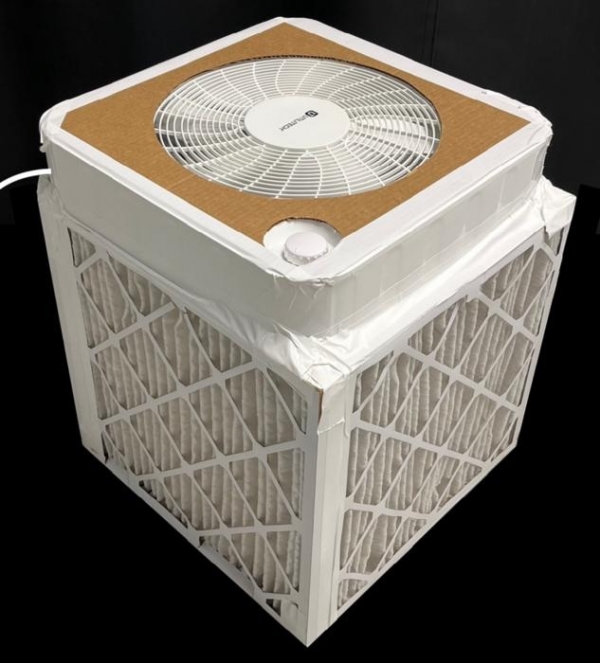
A Corsi–Rosenthal Box is a do-it-yourself air-cleaning device that combines a conventional electric fan with high-efficiency pleated filters.
The design provides a relatively large filter surface area through which air can pass.
The basic configuration used in the research incorporates:
- A standard box fan
- Four high-efficiency pleated filters
- Cardboard components
- Tape for assembly and sealing
The fan draws room air through the filters.
Airborne particles are captured within the filter material, while the fan returns filtered air to the surrounding room.
The system does not introduce fresh outdoor air. Instead, it repeatedly processes air already inside the room.
Why multiple filters can help
Compared with attaching a single filter directly to a fan, using multiple filters increases the available filtration surface area.
Depending on the fan, filter characteristics and assembly, this can improve airflow and the quantity of particles removed.
The United States Environmental Protection Agency (EPA) has evaluated several DIY air-cleaner configurations.
Its guidance indicates that devices incorporating multiple filters, thicker filter media and appropriate fan shrouds can provide higher clean air delivery rates than simpler designs.
However, individual units may perform differently.
Even devices built according to the same general design can have different performance because of variations in fans, filter specifications and assembly quality.
The effectiveness of a Corsi–Rosenthal Box therefore cannot be determined from appearance alone.
What did the 2026 researchers investigate?
The paper, titled Performance and Practical Considerations of Deploying Do-It-Yourself (DIY) Air Purifiers in Occupied Classrooms, was published online on August 5, 2026, and appeared in the September issue of ACS ES&T Air.
The research team included Sharmin Akter, Misti Levy Zamora, Kristina Wagstrom and colleagues associated with the University of Connecticut and collaborating institutions.
The study focused on how DIY filtration systems performed during actual university teaching sessions.
Earlier research had demonstrated the ability of Corsi–Rosenthal Boxes to remove airborne particles under various conditions.
However, testing in an occupied classroom presents additional practical challenges.
Occupants move, open doors, generate particles and change airflow patterns.
Noise and equipment placement can also influence whether a filtration system is acceptable in everyday use.
The researchers therefore investigated both particle-removal performance and practical operating considerations.
How were the classroom tests conducted?
The study evaluated two Corsi–Rosenthal Boxes in a rectangular university classroom without central ventilation.
Researchers monitored 59 class sessions involving approximately 14–30 students per session.
Each class lasted approximately 50 minutes.
During the first ten minutes, the filtration devices remained switched off.
This initial period provided a baseline for the measurements.
After ten minutes, the researchers activated both devices at a low fan speed.
The devices continued operating for the remainder of the class period.
This provided approximately 40 minutes of filtration during each session.
A before-and-after study design
The investigators used a within-session before-and-after approach.
Rather than comparing entirely separate classrooms, the researchers examined particle concentrations before and after activating the devices during the same class session.
This approach helped reduce differences associated with occupancy and certain environmental conditions.
However, a before-and-after study does not control every factor that might change particle concentrations during the observation period.
What pollutants were measured?
The study evaluated particle mass and particle-number concentrations, including measurements associated with PM1, PM2.5 and PM10.
PM1 describes particles with aerodynamic diameters of approximately one micrometre or smaller.
PM10 refers to particles with aerodynamic diameters of approximately ten micrometres or smaller.
These measurements allow researchers to assess different particle-size fractions.
The study also evaluated acoustic conditions, room-wide air movement and practical fan-safety considerations.
Multiple measurement locations were used to investigate whether reductions were distributed throughout the classroom.
What did the study find?
The most important reported result was a substantial reduction in fine airborne particulate matter.
Across the 59 sessions, the researchers found that PM2.5 mass concentrations decreased by an average of approximately 61% following activation of the filtration systems.
The interquartile range was 48–80.5%.
This means the middle half of the reported session-level reductions fell within that interval.
The value should not be interpreted as a guarantee that every classroom, student or individual sampling location will experience exactly a 61% reduction.
| Study characteristic | Reported result |
|---|---|
| University class sessions | 59 |
| Occupancy | Approximately 14–30 students |
| Air-cleaning devices | Two Corsi–Rosenthal Boxes |
| Observation period | Approximately 50 minutes per class |
| Filtration operation | Approximately 40 minutes per class |
| Average PM2.5 reduction | 61% |
| Interquartile range | 48–80.5% |
| Reported sound level at 2 metres | Approximately 52 dBA |
The American Chemical Society’s accompanying research announcement also reported decreases in ultrafine, fine and coarse particle concentrations.
However, the 61% primary numerical result is specifically reported in the published abstract for PM2.5 mass concentration.
It should not automatically be applied to every particle-size fraction.
Did the filtration work throughout the classroom?
An important practical question concerns whether portable air cleaners benefit only the immediate area around the device.
The researchers placed particle-measuring equipment at three locations within the classroom.
They found similar rates of particle removal across the monitored positions.
This suggests that the devices helped circulate filtered air throughout the studied room.
The result supports the practical feasibility of using portable filtration in occupied spaces.
However, it does not demonstrate that every individual breathing zone received identical exposure reduction.
Room dimensions, furniture arrangements, air-conditioning systems and airflow obstructions may influence how filtered air moves through other classrooms.
For larger rooms or irregularly shaped spaces, additional measurements may be necessary to evaluate the distribution of clean air.
Were the devices too noisy for teaching?
Noise is an important consideration when selecting classroom air-cleaning equipment.
A system that removes particles effectively but creates excessive background noise may interfere with teaching, conversation or concentration.
The ACS announcement reported operating noise measurements ranging from approximately 46 to 55 decibels.
The paper’s abstract reported approximately 52 dBA at a distance of two metres.
These measurements suggest that the tested units were not excessively noisy under the study conditions.
However, the results apply to the specific devices, fan settings, distance and room arrangement.
Higher fan speeds may increase clean-air delivery but can also produce greater noise.
The appropriate balance depends on room occupancy, existing background noise and the activities taking place.
A meeting room, classroom, library and examination hall may have different acoustic requirements.
Noise should therefore be considered alongside filtration performance when evaluating an intervention.
What did the researchers find about equipment safety?
The study also considered fire safety and equipment operation.
According to the published abstract, the investigators observed no elevated fire-safety risk in their evaluated conditions, including tests at an ambient temperature of approximately 30°C.
This is a useful practical finding.
However, it should not be interpreted as certification that every homemade filter assembly is safe under every operating condition.
Safety depends on the fan, electrical components, filter arrangement and maintenance.
The US EPA recommends using newer, appropriately certified box fans and following the manufacturer’s operating instructions.
Its guidance also emphasises safe positioning, suitable electrical connections and avoiding damaged equipment.
For schools and other public buildings, equipment selection should involve the appropriate facilities and safety personnel.
Devices should not obstruct exits, interfere with electrical systems or create avoidable hazards for occupants.
The classroom study did not establish the long-term safety or reliability of every possible locally assembled configuration.
Does particle filtration replace ventilation?
No.
Air filtration and ventilation serve different purposes.
Ventilation introduces outdoor air and removes or dilutes certain contaminants generated indoors.
Particle filtration removes airborne particles from air passing through the filter.
A filtration device that continuously recirculates indoor air does not, by itself, provide the outdoor-air exchange needed for adequate ventilation.
This distinction becomes particularly important in densely occupied classrooms.
Carbon dioxide
Building occupants release carbon dioxide when they breathe.
Indoor carbon dioxide concentrations can help professionals evaluate aspects of occupancy and outdoor-air ventilation when measurements are interpreted appropriately.
A conventional particle filter does not remove meaningful quantities of carbon dioxide.
As a result, a classroom may experience lower PM2.5 concentrations while still requiring improvements in outdoor-air ventilation.
Carbon dioxide measurement should not be treated as a complete assessment of infection risk or indoor air quality.
Gaseous pollutants
Some indoor contaminants occur primarily as gases rather than particles.
Examples include carbon monoxide and selected volatile organic compounds.
A conventional particle filter is not designed to remove all such pollutants.
Depending on the substance, effective control may require source removal, ventilation or appropriately designed gas-phase filtration.
Moisture and indoor comfort
Indoor humidity and temperature also influence building conditions.
A Corsi–Rosenthal Box is not a replacement for air conditioning, dehumidification or humidity management.
Where persistent moisture problems create conditions favourable to mould growth, the moisture source must be investigated and corrected.
Filtration may help remove some airborne particles, but it does not eliminate an active moisture problem.
The most effective indoor air-quality strategy considers source control, ventilation, filtration and building conditions together.
Can Corsi–Rosenthal Boxes prevent respiratory infections?
Reducing airborne particles may be a useful component of strategies for reducing exposure to infectious respiratory aerosols.
However, the 2026 classroom study did not measure infection rates.
It did not establish whether students experienced fewer respiratory illnesses, fewer absences or improved clinical outcomes.
The reported 61% PM2.5 reduction should therefore not be converted into a 61% reduction in disease transmission.
Airborne infection risk depends on multiple factors, including whether infectious individuals are present, the concentration of infectious aerosols, exposure duration, room ventilation, air cleaning and other controls.
Filtration can contribute to an integrated risk-reduction approach.
It is not a guarantee that infections will be prevented.
The US Centers for Disease Control and Prevention recommends improving ventilation and filtration in schools and childcare settings as part of broader infection-prevention measures.
These recommendations support attention to indoor air quality but should not be interpreted as a specific clinical effectiveness result from the University of Connecticut classroom experiment.
How much do DIY classroom air filters cost?
Cost is one reason Corsi–Rosenthal Boxes have attracted attention.
The American Chemical Society reported that the four pleated filters used in the DIY configuration cost approximately US$60.
The complete system also requires a suitable fan and other assembly materials.
Consequently, the figure should not automatically be described as the total installed cost of a complete classroom air-cleaning system.
The researchers and associated investigators noted that commercially available portable air cleaners can be substantially more expensive when compared on the amount of clean air delivered.
However, a reliable purchasing decision requires more than a simple comparison of initial prices.
Relevant considerations include:
- Equipment purchase cost
- Replacement filters
- Electricity consumption
- Expected service life
- Maintenance requirements
- Installation or assembly labour
- Availability of replacement components
- Verified clean-air delivery rate
- Noise performance
- Electrical safety requirements
- Local warranty and technical support
The US EPA explains that commercial portable air cleaners with known clean air delivery rates are generally preferred when dependable, standardised performance information is required.
DIY systems can be effective alternatives, particularly where cost or product availability is a constraint.
For Trinidad and Tobago, US purchasing prices should not be treated as local quotations.
Import costs, component availability, electricity requirements and maintenance arrangements would need to be evaluated separately.
What is clean air delivery rate?
Clean air delivery rate, or CADR, is a measure of the volume of filtered air a device can deliver over time for a specified particle size.
It provides an important basis for comparing air cleaners.
A higher CADR generally indicates greater particle-removal capacity under the conditions used to determine the rating.
However, the appropriate CADR for a room depends on factors such as room dimensions, occupancy, background ventilation and the performance objective.
A device with insufficient capacity may provide some particle removal without achieving the intended improvement throughout a larger occupied space.
The EPA notes that DIY air cleaners do not always have a known or standardised CADR.
For that reason, institutions should be cautious about assuming that two devices with similar external appearances provide equivalent performance.
Where air cleaning is being introduced as a formal building-management measure, equipment selection and performance verification are important.
What are the study’s most important limitations?
Although the results are promising, several scientific limitations affect their interpretation.
One classroom configuration
The research involved a defined university classroom environment.
The results may not translate directly to spaces with different geometry, ventilation, occupancy or particle sources.
Short observation periods
Each monitored class lasted approximately 50 minutes.
The experiment does not establish long-term performance over months or years of continuous use.
Before-and-after comparison
The researchers used initial measurements as a baseline before activating the devices.
This is a useful design, but changes in occupancy-related particle generation, outdoor conditions or natural particle removal may also influence measurements.
No direct health outcomes
The study measured particles rather than clinical health outcomes or actual infection rates.
Equipment-specific findings
The tested safety, acoustic and filtration results cannot automatically be generalised to all DIY fan-filter assemblies.
Incomplete full-text verification for this analysis
The publisher’s available abstract and ACS announcement establish the primary findings.
However, the complete article was not independently accessible during preparation of this Ecotox analysis.
Detailed calibration procedures, instrument-specific uncertainty, full statistical modelling and other methodological particulars not confirmed by those sources are therefore not presented as verified.
These limitations do not invalidate the reported particle reductions.
They define the evidence needed before drawing broader conclusions about other buildings or interventions.
What does the research mean for Trinidad and Tobago and the Caribbean?
Classrooms and other occupied buildings in tropical regions operate under environmental conditions that may differ from the university classroom studied in the United States.
Trinidad and Tobago has a mixture of naturally ventilated, mechanically ventilated and air-conditioned buildings.
The appropriate indoor air-quality strategy depends on each building’s characteristics.
Air-conditioned classrooms
Some buildings rely heavily on air conditioning for indoor thermal comfort.
However, air conditioning and outdoor-air ventilation are not necessarily the same thing.
An air-conditioning system may cool and recirculate indoor air without providing sufficient fresh-air exchange.
Where indoor air quality is a concern, the building’s ventilation arrangements should be assessed separately from its cooling performance.
Outdoor pollution entering buildings
Outdoor particles may enter through windows, doors, mechanical ventilation or gaps in the building envelope.
Potential sources can include vehicle emissions, nearby combustion activities, dust and other location-specific influences.
Whether those sources materially affect a particular classroom requires measurement or suitable supporting evidence.
Tropical humidity and moisture
Warm, humid conditions can create additional building-management challenges.
Where condensation, water intrusion or persistent moisture occurs, appropriate building maintenance and moisture control are necessary.
Particle filtration does not eliminate mould growth associated with an unresolved moisture problem.
Electricity and maintenance
A practical filtration intervention must remain functional after installation.
Schools and other institutions need suitable electrical equipment, maintenance procedures and a reliable supply of replacement filters.
If the equipment is not maintained, its effectiveness may decline.
Appropriate local testing
The US study demonstrates that low-cost filtration can work under defined conditions.
It does not establish that every classroom in Trinidad and Tobago requires the same number of devices, achieves the same reduction, or has the same pollution sources.
Local assessment and verification are necessary.
A practical framework for improving classroom indoor air quality
Educational institutions and building managers can use the following evidence-based framework.
Step 1: Identify the purpose of the investigation
Define the concern being addressed.
This may involve elevated particle concentrations, suspected outdoor pollution infiltration, inadequate ventilation, building moisture, occupant complaints or the evaluation of a proposed filtration system.
Different problems require different investigative methods.
Step 2: Characterise the building
Review room dimensions, occupancy, activities, air-conditioning arrangements and outdoor-air ventilation.
Identify possible indoor and outdoor pollution sources.
Examine whether building operations change during the day.
Step 3: Establish baseline conditions
Measure relevant parameters before making changes.
Depending on the investigation, these may include:
- PM2.5 and PM10
- Carbon dioxide
- Temperature and relative humidity
- Carbon monoxide or other relevant gases
- Noise levels
- Ventilation-related observations
- Outdoor air-quality conditions for comparison
The selection should be based on the investigation objectives rather than applying every test to every building.
Step 4: Evaluate possible interventions
Consider whether improvements are required to source control, maintenance, ventilation, filtration or moisture management.
Portable particle filtration may be useful where particulate concentrations are the principal concern.
However, it should not substitute for essential ventilation or corrective building maintenance.
Step 5: Select appropriate equipment
Assess room size, required clean-air delivery, noise, electrical safety, replacement filters and maintenance.
If DIY systems are being considered, verify the suitability of the components and assembly.
Step 6: Conduct a controlled pilot
Measure air-quality conditions before and after introducing the selected intervention.
Where practicable, retain similar occupancy and operating conditions.
Record operating settings and relevant outdoor conditions.
Multiple measurement locations may be needed to evaluate spatial variability.
Step 7: Evaluate effectiveness and uncertainty
Determine whether the intervention achieved the intended reduction in airborne particles.
Account for changes in outdoor conditions, occupant activity and baseline concentrations.
Do not treat a short-term improvement as proof of permanent performance.
Step 8: Establish maintenance and follow-up
Document filter-replacement procedures, equipment inspections and responsibilities.
Where warranted, repeat monitoring to confirm that performance remains acceptable.
An effective programme should provide information that supports maintenance decisions, not simply a one-time measurement.
How Ecotox can support indoor air-quality assessment
Ecotox Environmental Services Limited provides ambient air-quality, indoor air-quality and occupational monitoring services for organisations in Trinidad and Tobago and the wider Caribbean.
Its published capabilities include measurements relevant to:
- PM1, PM2.5, PM10 and other particulate fractions
- Carbon dioxide and carbon monoxide
- Selected indoor gaseous contaminants
- Temperature and relative humidity
- Thermal comfort and air movement
- Noise exposure
- Mould-related indoor environmental investigations
- Customised environmental monitoring programmes
These capabilities are relevant to identifying indoor environmental concerns, establishing baseline conditions and evaluating the effects of air-quality interventions.
For educational and commercial buildings, a structured assessment can help distinguish particulate problems from inadequate ventilation, moisture-related concerns or other environmental conditions.
Where advanced HVAC engineering, certified equipment performance testing or specialist infection-risk modelling is required, appropriately qualified specialists should be included.
Ecotox’s role is to provide relevant environmental measurements, investigation support and data interpretation within the confirmed scope of its services.
Learn more about Ecotox Ambient and Indoor Air Quality Testing.
Conclusion: Affordable air cleaning should be guided by measurable results
The 2026 ACS ES&T Air study demonstrates that appropriately constructed Corsi–Rosenthal Boxes can substantially reduce fine-particle concentrations in occupied university classrooms.
An average PM2.5 reduction of 61% across 59 monitored class sessions provides encouraging evidence that low-cost air filtration can be a practical part of indoor air-quality management.
However, the research does not establish corresponding reductions in disease transmission, nor does it show that air filtration can replace adequate ventilation.
The findings should also not be treated as a universal performance rating for every classroom or homemade filtration system.
For Trinidad and Tobago and the wider Caribbean, the opportunity is to develop evidence-based indoor environmental improvement programmes that are practical, affordable and properly evaluated.
That means understanding the sources of pollution, measuring existing conditions, selecting suitable interventions and verifying their effectiveness.
The most valuable air-quality improvement is not necessarily the most expensive system. It is the intervention that addresses the identified problem, operates safely and delivers a measurable, sustained improvement in indoor environmental conditions.
Sources
- Akter, S., Zamora, M. L., Gasparrini, W., et al. (2026). Performance and Practical Considerations of Deploying Do-It-Yourself (DIY) Air Purifiers in Occupied Classrooms. ACS ES&T Air, 3(9), 2328–2337. https://doi.org/10.1021/acsestair.6c00143
- American Chemical Society. (September 23, 2026). DIY Filter Systems Improve Air Quality in Classrooms. https://www.acs.org/pressroom/presspacs/2026/september/diy-filter-systems-improve-air-quality-in-classrooms.html
- United States Environmental Protection Agency. DIY Air Cleaners. https://www.epa.gov/emergencies-iaq/diy-air-cleaners
- United States Environmental Protection Agency. Research on DIY Air Cleaners to Reduce Wildfire Smoke Indoors. https://www.epa.gov/air-research/research-diy-air-cleaners-reduce-wildfire-smoke-indoors
- Centers for Disease Control and Prevention. Ventilation in Schools and Childcare Programs. https://www.cdc.gov/niosh/ventilation/guidelines/index.html
- University of Connecticut. Indoor Air Quality Initiative. https://indoorairquality.initiative.uconn.edu/
- Ecotox Environmental Services Limited. Ambient Air and Indoor Air Quality Testing. https://ecotoxes.ani.quest/services/air__noise_monitoring/ambient-air-quality-testing-ecotox/
- Ecotox Environmental Services Limited. Occupational Monitoring Services. https://ecotoxes.ani.quest/services/occupational_monitoring_services/