


Satellite Boom Creates New Atmospheric Pollution Risks Above Earth
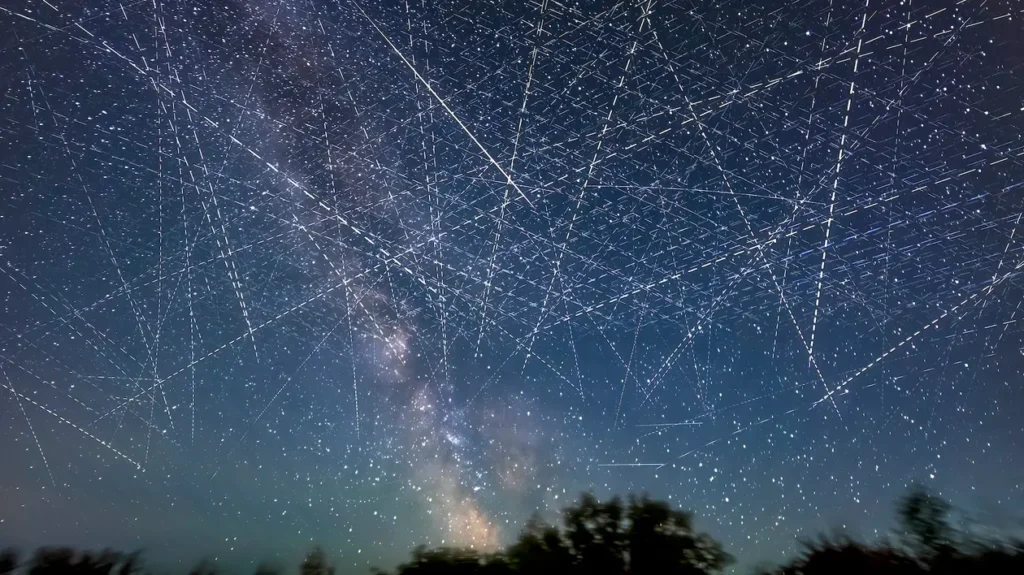
The rapid expansion of satellite fleets — from communication constellations to Earth-observation platforms — may be altering Earth’s upper atmosphere in ways that are poorly understood and potentially harmful. A recent Yale Environment 360 investigation highlights concerns about emissions from rocket launches and fragments that burn up on reentry. Yale E360
The Satellite Surge
Low-Earth orbit has shifted from dozens of satellites to tens of thousands in just a decade. SpaceX’s Starlink constellation alone has grown to over 9,000 active satellites, and industry forecasts suggest proliferation could exceed 100,000 active units by 2040. Yale E360
This dramatic increase stems from commercial, military, and scientific interests in space connectivity, Earth observation, and emerging industries such as space-based internet. Yale E360
Emissions from Launches and Reentries
Scientists are now warning of two types of pollution linked to this growth:
1. Rocket Launch Emissions
Rocket engines emit CO₂, black carbon, and other combustion byproducts directly into the stratosphere and mesosphere — layers above the air we typically monitor. This differs from surface emissions because pollutants at high altitudes linger longer and can interact with atmospheric chemistry more intensely. Yale E360
Research suggests that black carbon from rocket plumes can absorb solar radiation and warm upper atmospheric layers, weakening protective ozone and disturbing climate patterns. Yale E360
2. Ablation of Satellites and Rocket Stages
When satellites and spent rocket stages are deorbited, they usually burn up in the upper atmosphere, releasing metallic and synthetic particles (e.g., aluminum, copper, lithium). These materials can condense into aerosols that drift through the stratosphere for years or decades, with unknown effects on ozone chemistry and climate processes. Yale E360
Scientists caution that the magnitude and impacts of these emissions are not yet well quantified, and current industry growth outpaces scientific knowledge. Yale E360
Compounding Unknowns
Because launches and reentries inject pollutants into atmospheric layers where standard air quality monitoring doesn’t reach, the effects on weather, climate, and ecosystems remain uncertain. Field measurements — including high-altitude sampling, aircraft campaigns, and sounding rockets — are needed to validate and refine models. Yale E360
There is also concern that satellite debris — currently addressed as a space-traffic problem — may represent an emerging form of high-altitude pollutant deposition, akin to plastics or microplastics accumulating in ocean gyres. Yale E360
How Ecotox Environmental Services Can Help
While the satellite pollution niche lies at the cutting edge of atmospheric science, Ecotox’s current services provide relevant capabilities to support research, monitoring, and policy development:
- Atmospheric Sampling & High-Altitude Monitoring Design
- Design coordinated campaigns (aircraft, balloon, ground stations) to capture upper atmospheric emissions data for verification of modeled satellite plumes.
- Pollutant Fate & Transport Modeling
- Develop models to simulate how launch and reentry emissions disperse, oxidize, and affect stratospheric chemistry over time.
- Aerosol and Particle Characterization
- Analyze particulates that result from ablated satellite materials (metals, oxides) to determine composition, residence time, and potential radiative forcing.
- Risk Assessment & Policy Advisory
- Assess climate and ozone-layer risk implications; provide stakeholders with guidance on mitigation strategies, regulatory frameworks, or international governance approaches.
These services help clients move from sparse data to actionable insight — whether it’s designing measurement campaigns, informing regulators, or advising space-industry stakeholders on environmental implications.