


Microplastics in Water: Algae Offers Cleaner Removal
Introduction
Microplastics in water create growing risks for ecosystems, wastewater systems, and public health. A University of Missouri researcher has engineered algae that can capture harmful microplastics from polluted water. The same approach may also help clean wastewater and support future bioplastic production.
This research matters because microplastics move through ponds, lakes, rivers, wastewater, and food chains. They can pass through conventional treatment systems and enter drinking water sources. That makes water quality monitoring, contaminant monitoring, and ecological risk assessment increasingly important.
Study / discovery overview
The work was led by Susie Dai, a University of Missouri professor in the College of Engineering. She also serves as principal investigator at the Bond Life Sciences Center. Her team developed a special algae strain to help capture and remove microplastics from polluted water.
The method uses genetic engineering to make algae produce limonene. Limonene is a natural volatile oil that gives oranges their scent. In this system, limonene makes the algae water-repellent.
That feature matters because many microplastics also repel water. When the algae and microplastics meet, they bind together. They form clumps that sink and create a collectable biomass layer.
The approach targets three connected problems. It removes microplastics, supports wastewater cleaning, and may allow reuse of recovered plastics. Dai’s team aims to repurpose collected microplastics into safe bioplastic products, including composite plastic films.
Key findings
The engineered algae can grow in wastewater while feeding on excess nutrients. This means the algae may help clean water as it captures microplastics. That combination could make the process useful for future wastewater treatment plants.
The research remains in early stages. However, the long-term goal involves integrating the process into existing wastewater treatment plants. Cities could then remove microplastics more effectively while reducing pollution and creating useful materials.
The study also highlights why conventional wastewater treatment needs improvement. Many plants can remove larger plastic particles. Microplastics remain harder to capture because they are extremely small. They can slip through treatment systems and reach the wider environment.
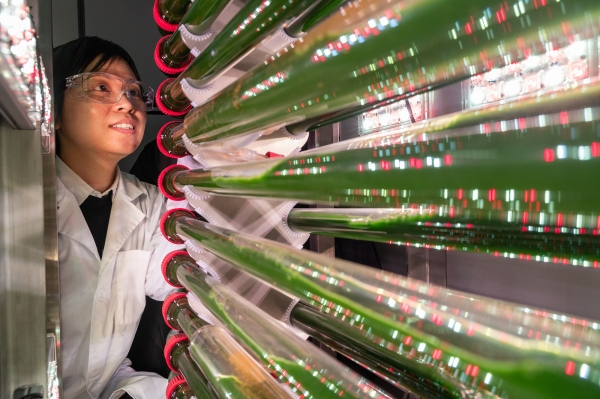
Dai’s laboratory grows algae in large tank bioreactors. The lab has built a 100-liter bioreactor named “Shrek” for processing industrial flue gas. Dai hopes to build larger bioreactors that could support wastewater treatment and other pollutant removal uses.
The research was published in Nature Communications under the title “Remediation and upcycling of microplastics by algae.” This shows growing scientific interest in treatment methods that combine removal, remediation, and resource recovery.
Broader implications
Microplastics in water show how persistent pollution can move through connected environmental systems. Plastic particles can travel from wastewater into rivers, lakes, sediments, organisms, and drinking water sources. This makes isolated testing less effective than integrated environmental monitoring.
The study also shows why wastewater innovation needs strong field validation. Lab results can guide new treatment ideas, but real wastewater systems contain complex chemical and biological mixtures. Monitoring program design must confirm performance under practical conditions.
For industries and municipalities, microplastic pollution creates compliance and reputational risks. Better contaminant monitoring can help identify plastic inputs, treatment gaps, and downstream impacts. Water quality monitoring can also track changes before and after treatment upgrades.
Sediment sampling may become especially important near discharge points. Microplastics and associated contaminants can settle in sediments over time. These particles may affect benthic organisms and broader aquatic food webs.
Soil sampling can also matter when wastewater, biosolids, or runoff reach land. Microplastics may accumulate in soils and interact with other contaminants. Fate and transport modelling can help explain how particles move across water, soil, and sediment systems.
This research also connects to ecological risk assessment. Microplastics can affect aquatic organisms, habitat quality, and ecosystem function. Exposure assessment can help evaluate risks to workers, communities, and sensitive receptors.
How Ecotox Environmental Services Can Help
Ecotox Environmental Services helps organisations assess water, sediment, soil, and ecosystem risks through science-based monitoring. For microplastics in water, Ecotox can support water quality monitoring and contaminant monitoring programs.
Ecotox can also help design monitoring programs for wastewater facilities, industrial sites, and receiving environments. These programs can identify pollution sources, treatment performance, and potential downstream impacts.
Sediment sampling and soil sampling can support wider microplastic and contaminant investigations. These services help determine whether pollutants have moved beyond discharge points or process areas.
Ecotox also supports environmental impact assessment, ecological risk assessment, and exposure assessment. These services help organisations understand environmental risks before they become compliance or ecosystem problems.
Where pollutant movement remains uncertain, fate and transport modelling can guide stronger decisions. This helps clients understand how contaminants may travel through water, soil, sediment, and ecosystems.
By combining environmental monitoring, pollution assessment, and environmental compliance support, Ecotox helps clients respond to emerging contamination challenges. Microplastic pollution requires that same integrated approach.
Internal link:
Ecotox Environmental Services environmental monitoring and assessment capabilities — https://ecotoxes.ani.quest/services/
Outbound citation:
Lab-grown algae removes microplastics from water — https://showme.missouri.edu/2026/lab-grown-algae-removes-microplastics-from-water/