


Turning Trash Into Jet Fuel: A High-Impact Path to Clean Aviation
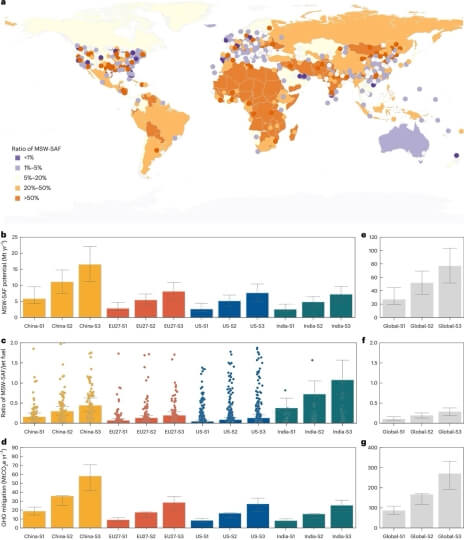
Harvard researchers, alongside the Harvard-China Project on Energy, Economy & Environment, are exploring a bold way to decarbonize aviation: converting municipal solid waste (MSW) into sustainable aviation fuel (SAF). Harvard SEAS+2chinaproject.harvard.edu+2 This approach could dramatically cut greenhouse gas emissions from jet fuel.
Key Insights from the Study
- A life-cycle analysis shows that jet fuel derived from city waste could reduce GHG emissions by 80–90% compared to conventional jet fuel.
- The process uses gasification + Fischer–Tropsch synthesis to convert MSW into a liquid fuel compatible with existing aircraft engines.
- Only ~33% of the carbon in input waste is converted to fuel in current designs, but efficiency could improve by capturing CO₂ or adding green hydrogen.
- Global potential: the study estimates that annual production could reach 50 million tons (62 billion liters) of fuel — reducing aviation emissions by ~16%.
- In a high-ambition scenario (with green hydrogen), production could rise to 80 million tons per year, satisfying up to 28% of global jet fuel demand.
- Economically, waste-based SAF could save airlines money under carbon-pricing systems (e.g. CORSIA), especially when supported by policy incentives.
Why This Matters
- Aviation is responsible for a growing share of global emissions (~2.5%), and demand for air travel is projected to double by 2040. Tech Xplore
- Using MSW as a feedstock avoids competing with food crops and leverages a waste stream that cities already generate in large volumes. Salata Institute+1
- This strategy supports both zero-waste goals and deep decarbonization, offering a drop-in fuel that works with today’s aircraft and infrastructure. chinaproject.harvard.edu
- Scalability remains a challenge: gasification needs scaling, and efficiency gains (e.g. via green hydrogen) are essential for full potential. Harvard SEAS
How Ecotox Environmental Services Can Help
Ecotox is well-positioned to support the development and scaling of MSW-derived SAF through:
- Waste Stream Characterization & Sampling
- Quantify the composition of MSW in target cities (organic fraction, plastics, metals) to assess suitability for gasification.
- Life-Cycle Assessment & Emissions Modeling
- Model full environmental impact of MSW-to-SAF pathways, including pre-treatment, gasification, hydrogen integration, and downstream emissions.
- Tech Feasibility & Scale-Up Advisory
- Support feasibility studies and scale-up planning, including evaluation of gasifier designs, CO₂ capture integration, and hydrogen sourcing.
- Regulatory & Policy Risk Assessment
- Provide risk assessments, regulatory roadmaps, and policy engagement strategies to align SAF development with incentives, subsidies, and compliance frameworks.